 TRIZ/USIT Paper: TRIZ/USIT Paper: |
  
|
USIT Solution Generation Methods
(Full Version) - Simplified System by the Reorganization of TRIZ Solution Generation Methods |
Toru Nakagawa (Osaka Gakuin Univ.),
Hideaki Kosha and Yuji Mihara (Fuji Photo Film Co., Ltd., Japan) |
Appendix to "Reorganizing TRIZ Solution Generation Methods into Simple Five in USIT"
ETRIA World Conference: TRIZ Future 2002, Strasbourg, France, Nov. 6-8, 2002 |
[Posted in Japanese translation on Sept. 18, 2002; posted in English on Nov. 19, 2002]
[Note added: Dec. 22, 2012]
|
For going back to Japanese pages, press
buttons.
Editor's Note (Toru Nakagawa, Nov. 19, 2002)
This document was originally presented as the Appendix to the paper at the ETRIA World Conference held on Nov. 6-8, 2002. The formation of this document and its significance are described in the paper posted here as a separate page:
"Reorganizing TRIZ Solution Generation Methods into Simple Five in USIT", Toru Nakagawa, Hideaki Kosha and Yuji Mihara, ETRIA World Conference 'TRIZ Future 2002', held at Strasbourg on Nov. 6-8, 2002; posted here in "TRIZ Home Page in Japan" on Nov. 19, 2002.
The USIT methods summarized here have been obtained by reorganizing the huge body of the solution generation methods in TRIZ (especially including Inventive Principles, Inventive Standards, and Trends of Technical Evolution) and by unifying them into an easy-to-understand hierarchical scheme. Thus the whole TRIZ know-hows are effectively applicable with the present methods to real problem solving.
In order to learn the principles and usage of the whole USIT method, specifically as the new framework for reorganizing TRIZ, please refer to the following paper:
"Experiences of Teaching and Applying the Essence of TRIZ with Easier USIT Procedure", Toru Nakagawa, presented at TRIZCON2002, St. Louis, Apr. 28-30, 2002; posted here in "TRIZ Home Page in Japan", May 16, 2002.
Contributions of various TRIZ principles and methods to the present USIT methods are referred in [ ] behind the detailed descriptions of USIT guidelines. The symbols and their references are as follows (see the Paper for more detail):
[P] TRIZ '40 Inventive Principles'
[Yuri Salamatov, "TRIZ: The Right Solution at the Right Time", Insytec, 1999.]
[S] TRIZ '76 Inventive Standards'
[Yuri Salamatov, "TRIZ: The Right Solution at the Right Time", Insytec, 1999]
[T] TRIZ 'Trends of Evolution of Technological Systems'
[Darrell Mann, "Hands-On Systematic Innovation", CREAX, 2002]
[H] Sickfus's Heuristics
[Ed Sickafus, "Unified Structured Inventive Thinking", Intelleck, 1997]
[Note (Toru Nakagawa, Dec. 19, 2012): TRIZ Tools, including 40 Inventive Principles, 76 Inventive Standards, and Trends of System Evolution, were all developed originally by Mr. Genrich Altshuller (Ref. G.S. Altshuller: "Creatrivity as an Exact Science!", Gordon & Breach Science Publishing, NewYork, 1984; G.S. Altshuller: "To Find an Idea", Nauka, Novosibirsk, 1986 (in Russian). They are refered here in English textbooks (Salamatov's and Mann's) which are more commonly available in Japan.]
Concerning to the schematic illustrates please refer to Section 3.3 of the Paper and the brief note at the end of this document.
This composes one of the four documents of "USIT Solution Generation Methods" as designed to fit readers' requirements of different levels and interests.
| Document |
Description |
Usage |
in English |
in Japanese |
(a) One-page reminder list
(A part of the present page) |
a list of titles of the submethods |
Reminder to be used during the USIT problem solving sessions by the people already learned the USIT methods |
Nov. 19, 2002
 |
Sept. 18, 2002
 |
| (b) Simple version |
guidelines and illustrations of the submethods |
For studying USIT at the beginner's level |
Nov. 19, 2002
|
Sept. 18, 2002
|
(c) Full version
(The present
page) |
detailed guidelines and illustrations of the submethods. (Appendix to the Paper) |
For studying USIT at its full extension |
Nov. 19, 2002
|
Sept. 18, 2002
|
| (d) Extended version |
detailed USIT guidelines and illustrations along with references to TRIZ methods |
For studying the reorganized TRIZ, especially for TRIZ practitioners |
Apr. 3, 2003
|
Sept. 18, 2002
|
For further easier reference to various TRIZ/USIT methods, various index pages are designed. Some of them are already posted in Japanese; in English, please give me some more weeks for preparation.
[Note (Apr. 3, 2003): Extend Version (d) and the Indeces to TRIZ/USIT methods are now posted in English.]
Editor's Note (Toru Nakagawa, Dec. 19, 2012)
In April 2003 I posted a set of 6 pages containing TRIZ tools (i.e., Inventive Principles, Inventive Standards, and Trends of System Evolution) with cross references among TRIZ and USIT tools. However, I withdrew them on Apr. 8, 2003, with my apology for my mishandling the copyright issues. After nearly 10 years, I have uploaded the whole set again today, with my statement of apology and thanks for the relevant authors. The pages are:
TRIZ and USIT Solution Generation Methods -- Cross References (Index top)
(1) TRIZ: 40 Inventive Principles (according to Salamatov's textbook)
(2a) TRIZ: 76 Inventive Standards (according to Salamatov's textbook)
(2b) TRIZ: Inventive Standards (according to Mann's textbook)
(3) TRIZ: Trends of System Evolution (according to Mann's textbook)
(4) Sickafus' 21 Heuristics (according to Sickafus' USIT textbook)
All these pages describe cross refererences among them and to the present USIT Solution Generation Methods (i.e. USIT Operators) in detail at the sub-method level. Thus their TRIZ --> USIT references are complementary to the USIT --> TRIZ references in the present page. I wish these pages be useful for understanding USIT and TRIZ further.
USIT Solution Generation Methods
USIT Solution Generation Methods (Contents. One-page Reminder) Sept. 18, 2002
| (1) Object Pluralization Method
a. Eliminate
b. Multiply into 2, 3, ..., inf.
c. Divide into 1/2, 1/3, ..., 1/inf.
d. Unify
e. Introduce or modify
f. Introduce from the Environment.
g. From solid to powder/liquid/gas
(2) Attribute Dimensionality Method
a. Deactivate a harmful
b. Activate a useful
c. Enhance a useful or suppress a harmful
d. Introduce a spatial attribute or
vary in space
e. Introduce a temporal attribute or
vary in time
f. Change the phase or the inner-structure
g. Attributes at the micro level
h. Properties of the system as a whole |
(3) Function Distribution Method
a. Reassign to a different Object
b. Divide the compound Functions
and assign them separately
c. Unify multiple Functions
d. Introduce a new Function
e. Vary the Function in space,
use space-related Functions.
f. Vary the Function in time.
g. Detection/measurement Function.
h. Enhance adapting/coordination/control
i. With a different physical principle
(4) Solution Combination Method
a. Combine functionally
b. Combine spatially
c. Combine temporally
d. Combine structurally
e. Combine at the principle level.
f. Combine at the super-system level
(5) Solution Generalization Method
a. Generalize/specify
b. Hierarchical system of solutions |
(1) Object Pluralization Method
Operate on each Object to 'Pluralize' it. 'Plural', in the sense of English language, means any number except 1; hence, 0, 2, 3, ..., ?, 1/2, 1/3, ..., 1/?, etc. Besides, introduce a new/modified Object.
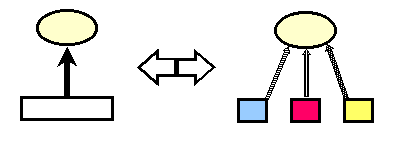
(1a) Eliminate the Object (into 0). (Simplification, Trimming)
| Eliminate the (subsidiary) Object in the system and reassign the Functions in the simplified system. |
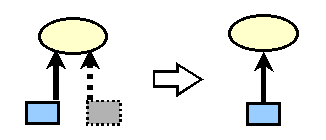 |
-
In a system having a complex structure (or a difficulty), eliminate (or trim) the Object (or a subsystem) having a subsidiary role (or the problem). Assign the Function(s), if necessary, to some existing Objects (or a newly-introduced simpler Object) or else to the super-system.
-
If the Object or a part of the Object becomes unnecessary/damaged/disturbing/harmful after performing its Function (or at its generation), eliminate it by use of decomposition/dissolving/evaporation/transportation/etc.
-
[P34a. Reject and regeneration of parts]
-
[S5-1.1.9 Introduction of substances under resticted conditions]
(1b) Multiply the Object (into 2, 3, ..., ?).
| Multiply the Object into 2, 3, ... , and infinitely many, then modify the properties of the Objects (slightly or largely), and use them together. |
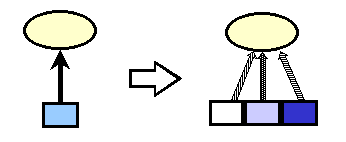 |
-
Multiply the Object into 2, 3, ..., and many, modify the properties of the (present and generated) Objects slightly (or largely), and use them together in the system.
-
[P7b. Nesting, P17c. Another dimension]
-
[T16. Mono-bi-poly (similar), T17. Mono-bi-poly (various)]
-
Multiply the Object into 2, 3, ..., and many, modify the properties of the Objects slightly (or largely), and combine them together into a complex Object, so as to obtain new properties and new functionality.
-
[P37b. Thermal expansion, P40. Composites]
-
Besides the present Object, intorduce a new Object having different properties or even a new Object having opposite properties, and make the system have higher/more complex properties and functionality.
-
[T18. Mono-bi-poly (increasing differences)]
-
In case of using multiple of similar Objects, make the number extremely large (or infinite).
-
[H17ab. Take to extremes (0 to infinity)]
(1c) Divide the Object (into 1/2, 1/3, ..., 1/?).
| Divide the Object into multiple parts (1/2, 1/3, ..., 1/?), modify the parts (slightly, or differently for different parts), and combine them for using together in the system. |
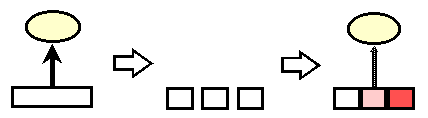 |
-
Divide the Objects into multiple parts and use them together. Guidelines for the division are:
- Divide it into mutually independent parts, such that each part is able to perform its own function better.
- Divide it into parts which are easy to assemble/disassemble.
- Divide it into parts, where specific part(s) are easy to replace/repair in case of their being broken, damaged, worn out, etc.
- Divide it into parts which are movable against one another.
- Divide it into parts so as to make the Object (or the system) flexible.
-
[P1ab. Segmentation, P15b. Dynamicity]
-
If a part of the Object has undesirable properties, or if multiple parts or multiple functions of the Object have undersirable inter-relationship, divide the Object into multiple separated parts so as to eliminate the interferance and to enable the parts to have their own desirable properties and functionality.
-
[P2ab. Taking away, P3c. Local quality]
-
Divide the Object into many (much) small parts and use them together as a group. Guidelines for the fine division are: [See (1g)]
- As the result of the fine division, make the fine parts easy to handle/transfer.
- As the result of the fine division, increase the surface area per weight and increase the interaction (among them or with other Objects).
-
[P1c. Segmentation]
-
[S2-2.2 Evolution of SFM, S5-1.2 Introduction of substances under resticted conditions]
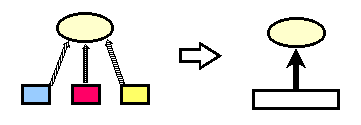
(1d) Unify multiple Objects into one.
| Combine multiple inter-related Objects in the system and turn them into one Object with unified structure and functionality. |
 |
-
Combine similar or different multiple Objects together in space and in time, make their functional links closer, and unify them into one compound Object.
-
Take multiple Objects performing differnt functions and generate a single versatile Object which can perform those functions in an unified way.
-
Connect (extremely) many finely-divided Objects and form a single (flexible) continuous Object.
-
[H17c. Take to extremes (0 to infinity)]
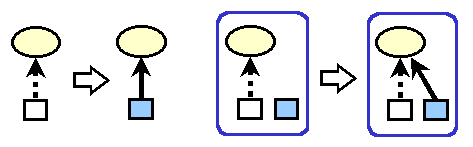
(1e) Introduce a new/modified Object.
| Modify the present Object in its properties or structure, or else introduce a new-type of Object having new properties and functionality, so as to achieve desirable effects and functionality. |
 |
-
As for the source for obtaining the Object (i.e., resource) to modify/introduce, consider in the following order of priority as guidelines:
- The current target Object (for modification)
- Objects (except the target Object) present in the system
- Objects readily available around the system (i.e., in the super-system or in the environment)
- A new type of Object which can effectively use the Field (i.e., the form of energy) present in the system
- A new type of Object having different properties and functionality
-
[S 5-1.1.9 Introduction of substances under resticted conditions, S 5-5.1,2,3 Obtaining substance particles]
-
As for the position of the Object being modified/introduced, consider in the following order of priority as guidelines:
- Inside the Object (or the Object itself) being the target of the principal function (or the problematic effect) in the system
- On (or attached to) the Object being the target of the principal function (or the problematic effect) in the system
- Inside the tool Object (or the Object itself) being the tool (i.e., working element) of the principal function (or the problematic effect) in the system
- On (or attached to) the tool Object being the tool (i.e., working element) of the principal function (or the problematic effect) in the system
- Between the target Object and the tool Object of the principal function (or the problematic effect) in the system (for playing the role of mediator/media/barrier/protector/etc.)
- Inside/on/between other functionally-related Object(s) in the system
- Inside/on/between the Object(s) around the system (i.e., in the super-system or in the environment)
- Between the system and its environment (for playing the role of mediator/barrier/etc.)
-
[P24a. Intermediary, P30b. Flexible shells and thin films, P39ab. Inert atmosphere]
-
[S1-1.2,3,7,8.1,8.2 Synthesis of SFMS, S1-2.1,3 Decomposition of SFMS]
-
As for the properties and functionality desirable to introduce as modified/new Object(s), guidelines are:
- In general, we want to introduce some properties/functionality which are insufficient/lacking at present and help realize the principal function of the system. Though such properties/functionality can range quite widely, the following items may be helpful as speciffic suggestions:
- Being able to achieve the same function (as far as the present problem concerns) with the present Object and being (much) less expensive and easier to handle than the present Object (such as cheap alternatives, copies, images, etc.)
- Enhancing and supplementing the principal function and being easier to handle/control
- Having different shape/structure, which introduces new type of properties/functionality
- Material having special properties, which introduce desirable properties/functionality in the system
-
[P14b. Spheroidality, P26abc. Use of copies, P27. Cheap short-life instead of costly long-life, P31bc. Porous materials, P40. Composites]
-
[S2-4.1,2,3,5 Complex-forced SFMS (F-SFMS), S4-1.2 Change instead of measurment and detection, S4-2.2,3 Synthesis of measurement system, S4-4 Transition to ferromagnetic measurement systems, S5-1.1.7,1.8,3 Introduction of substances under resticted conditions, S Mann Cc4 (D2)]
-
[T2. Space segmentation]
-
As for the way of introducing modified/new Object, guidelines are:
- Arrange it in space so as to make its properties/functionality most effective.
- Arrange it in time so as to make its properties/functionality most effective.
-
[P24b. Intermediary, P31d. Porous materials]
-
[S5-1.1.4,4 Introduction of substances under resticted conditions]
-
[T2. Space segmentation]
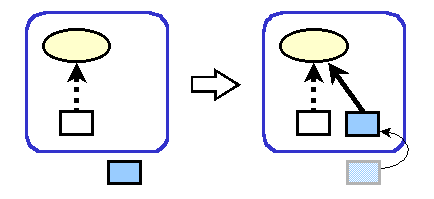
(1f) Introduce an Object from the Environment.
| Environment here means anything which is around the present system and is available easily and inexpensively. (Though this is pointed out in (1e) as the resource for obtaining an Object for modification and newly introduction, the use of the Environment is apt to be overlooked but important.) |
 |
-
[P25b. Self-service]
-
[S5-1.1.9 Introduction of substances under resticted conditions]
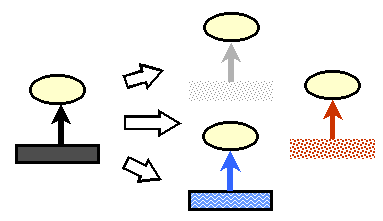
(1g) Replace a solid Object with a powder/fluid/liquid/gaseous Object.
Replace a solid Object in the system with powder Object, and further with fluid/liquid/gaseous Object, which may introduce characteristic properties such as fluidity, flexibility, operability, reactivity, etc. In relation to the replacement, a different kind of substance (or material) and a different mechanism of operation are often needed.
Note: This submethod (1g) may be regarded as an extension of submethod (1c) 'division of Objects', but is noted here because of the necessity of rather large change in the Object and in Functions. |
 |
-
[P29. Pneumatic and hydraulic structures, P30a. Flexible shells and thin films]
-
[T4. Object segmentation]
(2) Attribute Dimensionality Method
Each Object (or substance) has different kinds of properties (where each category of properties is called 'Attribute'); thus we consider to newly use/stop using/enhance/fully use such properties. Especially, it is important to distribute/vary useful properties in space (including the inner structure) and in time in an effective way. Improving the properties of the whole system is an important target, too.
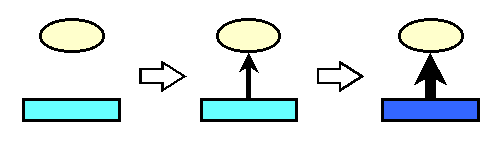
(2a) Deactivate/make irrelevant the harmful Attribute.
| Find any harmful properties in the system, and do not use them/make them irrelevant/turn them harmless/turn them into useful properties in the system. |
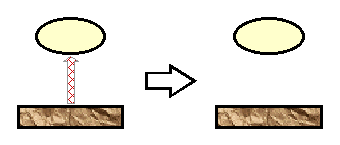 |
-
[P2b. Taking away, P22abc. Turn the harm to one's good]
-
[H15ab. Adversity]
(2b) Activate/involve a new useful Attribute.
| In the Object present in the system, start utilizing the Attribute (properties) (which has not been used yet) or introduce a new Attribute by modifying the Object. Further, if appropriate, replace the present Object with a new Object (or material) having such a useful Atribute and introduce a new function (or Field) which make the new properties effective. There are different sorts of Attributes. Consider the following types of Attributes: |
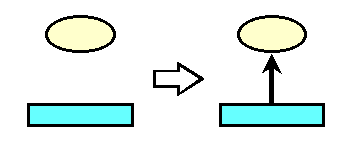 |
-
Use Attributes related to optical properties of Object; e.g. color, transparency, refractive index, reflective index, etc.
-
[P32a. Changing color]
-
[T21. Increasing use of colour, T22. Increasing transparency]
-
Use Attributes realted to thermal properties of Object; e.g. temperature, thermal extension ratio, thermal conductivity, specific heat, heat of evaporation/melting, etc.
-
[P35d. Change of physical and chemical parameters, P37ab. Thermal expansion]
-
Use Attributes related to mass and weight; e.g. weight, density (specific weight), mass distribution, etc.
-
[S5-1.4 Introduction of substances under resticted conditions]
-
[T7. Decreasing density]
-
Use Attributes related to size and shape of the Object; e.g. length, area, volume, shape, etc.
-
[P4ab. Asymmetry, P14b. Spheroidality]
-
[T8. Increasing asymmetry (to match external asymmetry) ]
-
Use Attributes related to the surface, structure, and inner structure of the Object
-
[P30. Flexible shells and thin films]
-
[T2. Space segmentation, T3. Surface segmentation]
-
Use Attributes related to mechanical properties of Object; e.g. flexibility, strength, hardness, vibrational characteristics (resonance frequency, etc.), etc.
-
[P35c. Change of physical and chemical parameters]
-
[S4-3.2,3 Improvement of measurement systems]
-
Use Attributes related to electrical properties of Object; e.g., electirical conductivity, electrical capacitance, electirc charge, voltage, etc.
-
Use Attributes related to magnetic and electro-magnetic properties; e.g. magnetism, magnetic succeptibility, etc.
-
[S2-4.1,2,4,6 Complex-forced SFMS (F-SFMS)]
-
Use Attributes related to chemical properties of Object; e.g. material, composition, concentration, chemical reactivity, dissolving power, etc.
-
[P33. Homogeneity, P35b. Change of physical and chemical parameters, P38abcde. Strong oxidizers, P39ab. Inert atmosphere]
-
Use Attributes related to the properties of physical change (i.e. phase transition) and chemical change of the Object.
-
[S5-1.1.8,3 Introduction of substances under resticted conditions, S5-3.1 Use of phase transitions, S Mann Da6 (D3)]
-
Use Attribute related to special/functional properties of the Object; e.g. energy conversion, information conversion, etc.
-
[S Mann Cc4, Ce3 (D2)]
-
[T1. Smart materials]
-
[H21. Transduction ]
-
Use Attribute related to the operational properties of Object/System, which support the function of the system in a general sense; e.g. operability, controllability, manufacturability, etc.
-
[S1-1.2 Synthesis of SFMS, S4-2.1 Synthesis of measurement system, S5-1.1.4 Introduction of substances under resticted conditions]
(2c) Enhance the useful Attribute or suppress the harmful Attribute.
| Enhance the useful but insufficient Attribute or suppress the harmful/excessive Attribute. The same kinds of Attrributes are handled as used in the previous submethod (2b). |
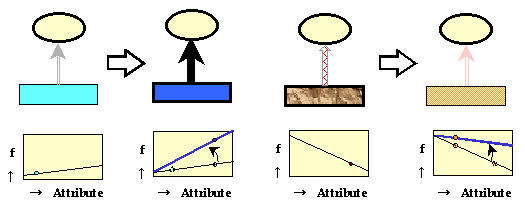 |
-
Redesign the Attributes of the Objects, their parts, or the Environment, in a way such that they satisfy the required/desirable conditions and perform the required/desirable Functions. It may often be necessary to modify/introduce an Object and/or to modify/introduce a Function.
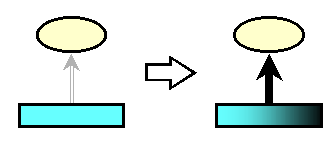
(2d) Introduce/enhance a spatial Attribute or distribute/vary in space a harmful/useful Attribute or Attribute's value.
| Introduce or enhance an Attribute related to the space, or activate an Attribute (or vary the Attribute's value) depending on different places in space (or different parts of an Object). |
 |
-
Introduce/enhance spatial order/structure in the spatial placement or structure of the Object(s).
-
[H8abcd. Order of objects, H9ab. Shape-change, H10abcd. Change periodicity of a pattern, H13abc. Superpose/separate/differentiate objects]
-
Introduce/enhance a space-related Attribute which has not been (or has been) utilized before.
-
[P7a. Nesting, P14ab. Spheroidality, P17cde. Another dimension]
-
Introduce spatial structure or inner-structure of Object(s) and vary the Attribute(s) (or the values of the Attribute(s)) depending on different places (or different parts of Object(s)).
-
[P3ab. Local quality, P40. Composites]
-
[S5-1.1.5 Introduction of substances under resticted conditions]
-
[T8. Increasing asymmetry (to match external asymmetry), T9. Boundary breakdown]
-
[H10abcd. Change periodicity of a pattern, H11abcd. Symmetry, H12ab. Localize/delocalize the problem]
-
Introduce/enhance the Attribute(s) related to the spatial motion of Object(s).
-
[P13b. Other way round, P15ac. Dynamicity]
-
[S2-2.4 Evolution of SFM, S2-4.8 Complex-forced SFMS (F-SFMS)]
-
[T10. Geometircal evolution (linear), T11. Geometric evolution (volumetric), T12. Dynamization ]
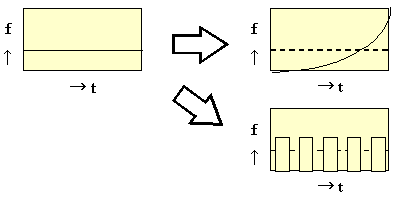
(2e) Introduce/enhance a temporal Attribute or distribute/vary in time a harmful/useful Attribute or Attribute's value.
| Introduce/enhance the temporal Attribute(s) related to the operational phases, duration of operations, time frequency, etc. of the system, and depending on such temporal conditions activate different Attributes or vary the values of the Attributes in time. |
 |
-
Introduce/enhance the temporal Attributes related to the operational phases, duration of operation, time frequency, etc. of the system.
-
Depending on various temporal conditions of the system, activate different Attribues or vary the values of the Attribute(s) at different times.
-
[H1b. Unify out-of-phase functions, H14ab. Eliminate/introduce time]
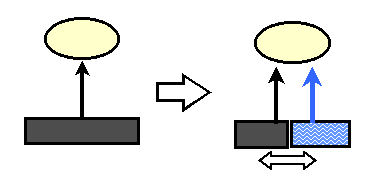
(2f) Change the phase, utilize the phase change, or change the inner-structure of the Object.
| Change the phase (i.e. state of condensation) of Object(s) , utilize the phase change, or introduce/change the inner structure at the micro level for using various Attributes thus activated/enhanced. |
 |
-
Change the phase (solid, liquid, gas, etc.) or the state of condensation of Object(s).
-
[P29. Pneumatic and hydraulic structures, P35a. Change of physical and chemical parameters]
-
[T4. bject segmentation]
-
Utilize the phase change of the substance(s) of Object(s), and further utilize the physical effects involved by the phase change and also use special properties related to the coexistence of two phases.
-
[P36a. Phase transitions]
-
[S5-3.1,2,4,5 Use of phase transitions, S5-4.1,2 Use of physical effects]
-
Introduce/enhance (heterogeneous or ordered) inner structure into the Object(s) (for example, by introducing voids and porous structure), and utilize new properties and Functions involved by the inner structure.
-
[P31a. Porous materials]
-
[S2-2.3,6 Evolution of SFM, S 5-1.1.1 Introduction of substances under resticted conditions]
-
[T2. Space segmentation, T6. Webs and fibres]
-
Combine multiple materials (or substances) to compose a complex inner-structure matrial and introduce an Object with the material and use the new properties and Functions thus introduced.
-
[P31d. Porous materials, P40. Composites]
-
[T2. Space segmentation]
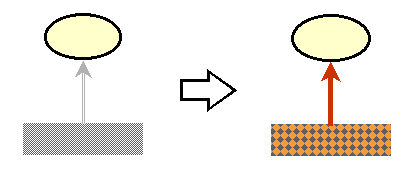
(2g) Utilize Attribute(s)/properties at the micro level.
| Consider/design the structure/properties/interactions of Object(s) at the micrometer or nanometer (or even smaller) scale, and solve the problem from the micro-level principles. |
 |
-
Instead of the ordinary macro scale, use the micrometer-, nanometer- or even smaller scale in space, consider the structures/properties/interactions of Object(s) in such a micro scale from their proper principles, and implement a system based on such observation for solving the problem.
-
[S3-2.1 Transition to microlevel]
-
[T5. Evolution macro to nano scale (and beyond) (space)]
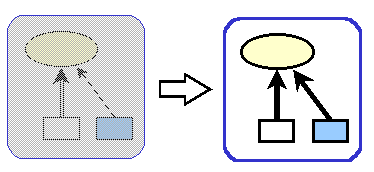
(2h) Improve the properties/performance of the system as a whole.
| (Besides the Attributes and Functions of the Objects as the components of the system,) consider the properties (or Attributes) and Functions of the system as a whole and improve them by designing/implementing/improving the system and its components. |
 |
-
If the present system lacks some components to form a technical system even at its minimal level, introduce the missing Object(s) or Function(s) into the system to make it work as a technical system.
-
[S1-1.1 Synthesis of SFMS]
-
Set the target of desirable properties and Functions of the system as a whole and design/implement/improve the system and its components so as to improve such properties and Functions. Some examples of the desirable properties and Functions of the system are:
- efficiency of the energy usage
- minimizing the human involvement and improving the intelligence
- ideality of the system (i.e., (principal useful function)/(mass + size + energy use + harmful functions)).
- robustness
- satisfaction of the market demands and customer requirements
-
[P12. Equipotentiality]
-
[T15. (Matching to external) non-linearities, T23. Customer purchase focus, T24. Market evolution, T25. Design point, T29. Reducing human involvement, T30. Design methodology, T31. Reducing number of energy conversions (tending to zero)]
(3) Function Distribution Method
For the purpose of achieving/improving the principal useful Function of the system, distribute/rearrange various useful Functions (and some harmful Functions subsequently appearing) among the Objects which are already present, modified, or newly introduced into the system. Various Functions need to be transferred, divided, unified, or introduced. It is necessary to distribute/vary the Functions in a suitable way in space and in time, and further for better working of the system it is the key to utilize higher-level Functions for adapting/controlling etc.
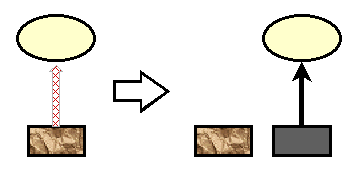
(3a) Reassign the Function to a different Object.
| Reassign (or transfer) the present Function to a more suitable different Object which are already present or newly introduced in the system. |
 |
-
Find an insufficient/excessive/hamful Function of an Object in the system, and reassign (or transfer) the Function to a different Object (either already present or newly introduced) so as to make the Function effective/useful/non-harmful.
-
[P2a. Taking away, P24a. Intermediary]
-
[S5-2.2 Introduction of fields under restricted conditions]
-
Replace the insufficient useful Function in the system with a similar but more effective and controllable Function probably based on a different physical principle. Accompanying this replacement of the Function, often the Objects and the Fields (i.e., physical interactions) relevant to the Function need to be replaced as a set.
-
[P28. Mechanical principle replacement, P29. Pneumatic and hydraulic structures]
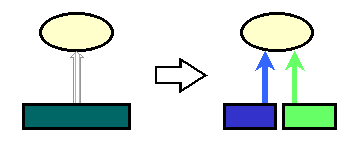
(3b) Divide the compound/multiple Functions and assign them to different Objects or different parts of an Object.
Divide the compound/multiple Functions present in the system and reassign the divided Functions to
different Objects (already present or newly introduced) or different parts of Objects. |
 |
-
Divide the compound/multiple Functions (or non-separated multiple Functions) which are born by one Object, and assign the individual Functions to different Objects or different parts of Objects so as to let them work more effectively.
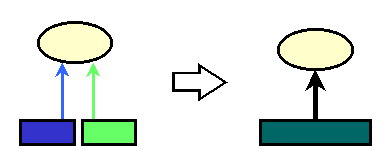
(3c) Unify multiple Functions and assign the unified Function to an Object.
| Unify multiple Functions of multiple Objects and assign the unified Function to one Object. |
 |
-
Unify multiple Functions presently born by multiple Objects and assign the unified Function to a new/modified (or compound) Object so as to perform the present Functions simultaneously. If any Object becomes redundant consequently, eliminate it.
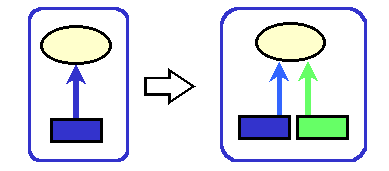
(3d) Introduce a new Function to assign to an Object.
| In order to achieve the target of the system or to solve the problem, introduce a new Function and assign it to an Object either present/modified or newly introduced. |
 |
-
As for the source of the Function which is going to be introduced into the system (or into the component(s) of the system), guidelines are:
- Utilize the Field which is already present in other parts of the system or in the environment.
- Introduce a Field which can utilize or are cooperative/compatible with the properties of the Objects present in the system.
- Introduce new types of substances and a new Field as a set so as to implement a useful and effective Fnction.
- Introduce a new Function in such a way that it cooperates/enhances/complements/prevents/ protects/ensures/controls other Functions in the system.
-
[P13a. Other way round, P22a. Turn the harm to one's good]
-
[S1-1.7 Synthesis of SFMS, S1-2.4 Decomposition of SFMS, S5-1.1.2 Introduction of substances under resticted conditions, S5-2.2,3 Introduction of fields under restricted conditions, S Mann Ce3 (D2)]
-
As for the types of Functions which are desirable to introduce, consider the following Functions categorized with the Fields (i.e., interactions/forces/energies/fields/etc.) in the sense of TRIZ, as guidelines:
- Functions related to the mechanical Fields,
- Functions related to the thermal Fields,
- Functions related to the electrical Fields,
- Functions related to the magnetic/electromagnetic Fields,
- Functions related to the optical Fields,
- Functions related to the chemical/biochemical Fields,
- Functions related to the visual/aural/tasting/smelling senses, etc.
-
[P8ab. Counterweight, P14d. Spheroidality, P18def. Mechanical vibrations, P36a. Phase transitions]
-
[S2-4.1 Complex-forced SFMS (F-SFMS), S5-3.5 Use of phase transitions]
-
[T21. Increasing use of colour]
-
[H21. Transduction]
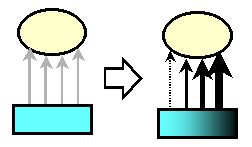
(3e) Distribute/vary the Function in space or utilize the spatial distribution/motion/vibration Function.
| Distribute/arrange the Function(s) in some spatial order/structure and increase the degree of spatial freedom. Utilize/enhance the spatial Function(s) of distributing/moving/vibrating the Object(s) (or the Attribute(s) of Object(s)). |
 |
-
Concerning spatial positions where the Functions act, arrange the (multiple) Function(s) in the system in a spatial order/structure/variation so as to be able to work effectively, and increase the degree of freedom of the spatial arrangement, and further enable its temporal variation.
-
[S2-2.5 Evolution of SFM, S2-4.9 Complex-forced SFMS (F-SFMS)]
-
[T10. Geometircal evolution (linear), T11. Geometric evolution (volumetric), T26. Degrees of freedom]
-
Introduce/enhance the Function(s) of spatially distributing/moving/transferring the Object(s).
-
[P14c. Spheroidality, P17abd. Another dimension]
-
Use the vibration of the Object(s), and further use resonance vibration and supersonic vibration.
-
[P18abcde. Mechanical vibrations]
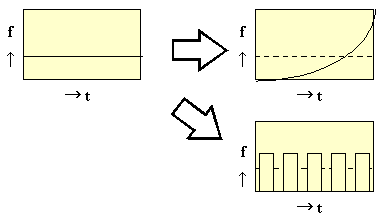
(3f) Distribute/vary the Function in time.
| Set the time (or timing) of operation of the Function(s) in an appropriate way. Set the timing of operation of a Function, in the sense of time period of operation (such as triggering event, operational conditions, etc.), temporal variation in the long time range, and temporal variation in the short time range (e.g., in pulses, in cycles, frequency, etc.), and also set the timing of multiple Functions in the sense of the sequential order, the relative timing of operations, etc. |
 |
-
Distribute/vary the Function(s) in time.
-
[S1-2.5 Decomposition of SFMS, S2-2.5 Evolution of SFM, S2-4.9,10 Complex-forced SFMS (F-SFMS)]
-
[H1b. Unify out-of-phase functions]
-
If there is some problem in performing the principal Function in a simple way, perform a preparatory Function in advance, perform a protective Function in parallel on a temporary basis, or perform a post-Function afterwords. Also change/invert the order of performing the Functions.
-
[P9a. Prior counteraction, P10b. Prior action, P16. Partial or excessive action, P21. Skip, P24b. Intermediary]
-
[S1-1.6 Synthesis of SFMS]
-
[H2ab. Sequence of events, H7ab. Initiation of event]
-
Enable the Object(s) in the system to perform the desired Function(s) continuously (for a long period of time, even in varying situations).
-
[P20ab. Useful action continuity, P34b. Reject and regeneration of parts]
-
Perform the Function(s) at higher speed/rate, in pulses, or in periodical way. Perform the Function(s) in coordination with the resonance frequency of the system (or its part).
-
[P18bc. Mechanical vibrations, P19ab. Periodic action]
-
[H3abcd. Rate of events, H4abc. Periodicity]
-
Coordinate the timing of performing multiple Functions in a way to work cooperately at the same time, in sequence/cycle, or to work alternately for avoiding interference.
-
[P 19c. Periodic action]
-
[S2-3.1,2,3 Evolution by coordinating rhythms]
-
[H2c. Sequence of events]
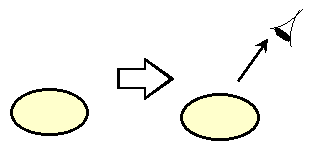
(3g) Realize the detection/measurement Function.
| Perform the detection/measurement Function as simply and quickly as possible (especially, make the detection/measurement itself unnecessary, if possible) and by using Attributes sensitive and accurate for detection/measurement. [See (3h) also.] |
 |
-
[S4-1.1,2,3 Change instead of measurment and detection]
-
[T20. Increased use of senses]
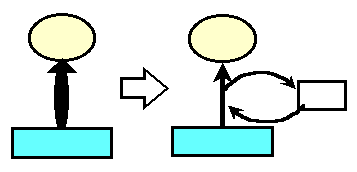
(3h) Introduce/enhance the adapting/coordination/control Function.
| Introduce/enhance Function(s) for adapting/coordinating/controlling the system and make the system higher and more intelligent. |
 |
-
Reduce the human involvement in the system as a basic step of improvement.
-
[T29. Reducing human involvement]
-
Introduce (or replace with) a Field easier to controll in the system.
-
[S2-1.2 Transition to complex SFMS, S2-2.1 Evolution of SFM, S2-4.11,12 Complex-forced SFMS (F-SFMS)]
-
Repalce the Object with the one made of materials adaptable or easier to control.
-
[T1. Smart materials]
-
[S2-4.7 Complex-forced SFMS (F-SFMS)]
-
Set the substance in selected places so that the Function is applied adaptively onto the selected places.
-
[S1-1.8.1,8.2 Synthesis of SFMS, S5-4.2 Use of physical effects]
-
Coordinate the timing and Functions of system operation.
-
[T13. Action co-ordination, T14. Rhythm co-ordination]
-
[H6abc. Synchronization/out-of-phase/differentiate events]
-
Introduce/enhance the feedback system or other coordination/control mechanism in order to coordinate and control the Functions in the system.
-
[P23ab. Feedback]
-
[S2-1.1 Transition to complex SFMS]
-
[T15. (Matching to external) non-linearities, T28. Controllability]
-
[H5abce. Feed-back]
-
Implement the Function of coordinating/adjusting the actions of the Objects by themselves or repairing the Objects by themselves, in a way of self-service.
-
[P25a. Self-service, P34b. Reject and regeneration of parts]
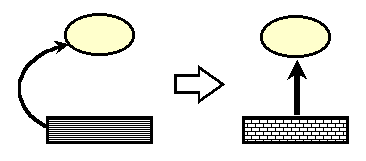
(3i) Achieve the Function with different physical principle.
| In place of the present Function (especially the one achieved by gravitational or mechanical principles), achieve the similar Function in a more effective and controllable way on the basis of a different physical principle. |
 |
-
[P28. Mechanical principle replacement, P29. Pneumatic and hydraulic structures]
(4) Solution Combination Method
Combine multiple solutions (or multiple elements of solutions) in various ways (such as functionally, spatially, temporally, structurally, at the principle level, etc.) so as to form a new solution which enhances the strong points, complements the drawbacks, and overcomes the contradictions. Also solve the problem by transferring to the super-system level.
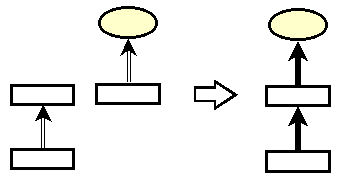
(4a) Combine solutions functionally.
| Combine multiple solutions by linking their Functions. Especially, combine multiple solutions by linking Functions which are related in causal relationships or by combining Functions which are complementary or contrary with one another. |
 |
-
Combine multiple solutions having Functions in sequence in the causal relationship and form a better solution by performing the Functions in sequence in time.
-
[P16. Partial or excessive action, P25b. Self-service]
-
[S1-1.6 Synthesis of SFMS, S4-1.2 Change instead of measurment and detection]
-
Combine multiple solutions having Functions in sequence in the causal relationship and form a better solution by performing the Functions simultaneously so that one Function extends/enhances/suppresses/protects/etc. the other.
-
[P18f. Mechanical vibrations, P22a. Turn the harm to one's good]
-
[S1-1.8.1,8.2 Synthesis of SFMS, S4-2.1 Synthesis of measurement system, S4-3.1,2 Improvement of measurement systems]
-
Combine multiple solutions having complementary or contrary Functions and form a better solution by implementing the Functions in different parts of the system or by implementing the Functions after unification.
-
[P3c. Local quality, P6. Universality]
-
[T13. Action co-ordination ]
-
Combine multiple solutions and form a better solution by implementing a functional hierarchical structure containing adapting/controlling/learning mechanism.
-
[S1-2.5 Decomposition of SFMS, S2-1.1,2 Transition to complex SFMS, S2-4.11,12 Complex-forced SFMS (F-SFMS)]
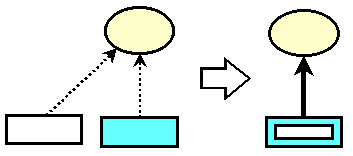
(4b) Combine solutions spatially.
| Combine multiple solutions in respect to the spatial positions to apply; for instance, at different places (for avoiding the mutual interferrence), at distributed places, side by side, in front and back (in sequence), on top and bottom, at the same place alternatively, inside of the other, as an inner-structure of the other, etc. |
 |
-
[P7ac. Nesting, P12. Equipotentiality, P17ce. Another dimension, P31d. Porous materials]
-
[T2. Space segmentation, T3. Surface segmentation]
-
[H13abc. Superpose/separate/differentiate objects]
(4c) Combine solutions temporally.
| Combine multiple solutions in respect to time to apply; for instance, in sequence (one after another), beforehand of the other, simultaneously (in parallel), afterwards of the other, in the reverse order, alternatively, in pulses, periodically, from time to time, interrupting/switching corresponding to the situations, etc. |
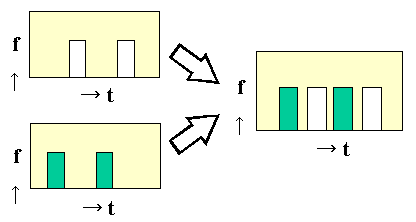 |
-
Perform one Function (of one solution) beforehand as a preceeding process for doing the other (principal) Function (of the other solution).
-
[P9a. Prior counteraction, P10ab. Prior action, P11. Early cushioning]
-
Perform one Function (of one solutions) afterwards as a post-process for doing the other (principal) Function (of the other solution).
-
[P34a. Reject and regeneration of parts]
-
[S5-1.1.8 Introduction of substances under resticted conditions]
-
Perform multiple Functions of multiple solutions at the same time in parallel (or alternatingly).
-
[P19c .Periodic action, P34b. Reject and regeneration of parts]
-
[T14. Rhythm co-ordination]
-
Combine multiple solutions so as to perform them alternatively by switching them dynamically corresponding the surrounding situations.
(4d) Combine solutions structurally.
| Combine multiple solutions by forming a (hierarchical) functional structure in such a way that the solutions are performed alternatively under different conditions or performed at different levles. |
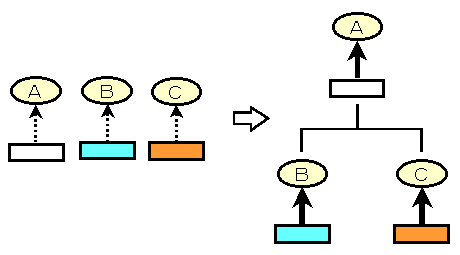 |
-
Combine multiple solutions so as to perform them alternatively under different conditions.
-
[P3d. Local quality, P15d. Dynamicity]
-
[T25. Design point, T30. Design methodology]
-
Combine multiple solutions so as to perform them at different levels (such as the whole system level and the subsystem level).
-
[S3-1.5 Transitions to bisystem and polysystem]
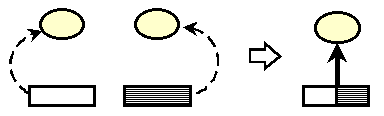
(4e) Combine solutions at the principle level.
| Combine multiple solutions based on different principles and form a solution in various ways; for instance, as a temporary solution in the transient stage, in a hybrid system, in a compromise, to back-up the other, to perform on a background of the other, etc. |
 |
-
[P28. Mechanical principle replacement]
-
[T29. Reducing human involvement]
-
[H16. Invoke contradiction/examine opposites, H20ab. Simplify/complex]
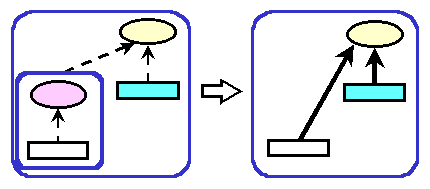
(4f) Combine solutions at the super-system level.
| Consider the higher-level purpose or principal function which should be performed by the system in the problem and solve the current problem by combining/coordinating the present system with the neighboring system(s) and forming/improving the higher-level system (i.e. the super-system). |
 |
-
[S2-1.1 Transition to complex SFMS, S3-1.1,2,3,4 Transitions to bisystem and polysystem]
(5) Solution Generalization Method
Represent a solution in a more general way, form a solution template, and obtain concepts of solutions in the associative manner. Also generate a hierarchical system of solutions.
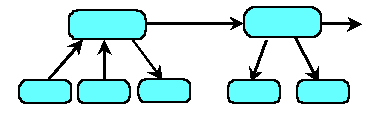
(5a) Generalize/specify the solution for associative thinking.
| Replace the technical/specific terms in a solution with plain/generic terms, form a plain solution template, and then obtain new specific conceptual solutions in an associative way. |
 |
-
[H18ab. Genericize object's functions, H19. Genericize solutions]
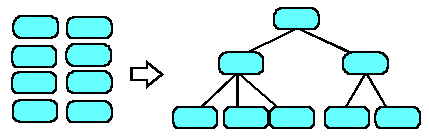
(5b) Construct a hierarchical system of solutions.
| Classify a number of solutions obtained so far, make a hierachical system of solutions with respect to the levels of generalization, consider the overall view of the solution space, and try a comprehensive search of solutions. |
 |
Notes of Symbols for Illustrations:
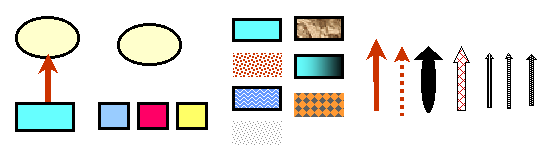
Objects: Oval: Object, especially Target Object which is affected by the Function.
Rectangles: Objects, especially Tool Objects which act with the Function.
Attributes: Attributes are sorts (or categories, and not values) of properties of Objects.
Shown with different colors and patterns for each object.
The patterns in the above figures intend: Solid, Powder, Liquid, Gas,
Hazardous, Varying in space, and Micro-level properties of Objects..
Functions: Shown with different styles of arrows.
solid arrow: useful Function
broken-line arrow: (useful but) insufficient Function
fat arrow: excessive (and hence rather harmful) Function
crossed arrow: harmful Function
Three different patterns of arrows for showing different Functions.
Solutions: Shown with round-cornered rectangles.
Last updated on Apr. 3, 2003. [Note added: Dec. 22, 2012] Access point: Editor: nakagawa@ogu.ac.jp