| et's enjoy 'Think & Try' !
(for Children and Highschool students)
Editor: Toru Nakagawa
Last updated: Feb. 24, 2019 |
For solving problems creatively
(for Students and the General public)
 Social Problems Social Problems
Editor: Toru Nakagawa
Last updated: Dec. 13, 2018 |
Methods of creative problem solving
(for Engineers and Researchers novice to TRIZ)
Editor: Toru Nakagawa
Last updated: Jan. 10, 2019 |
Practices and methodologies of Creative problem solving
(for Practitioners and Experts)
Editor: Toru Nakagawa
Last updated: Jan. 10, 2019 |
|
 |
| This home
page serves as an open forum of information exchange for better
understanding
and usage of Creative Problem Solving Methodologies, especially
based
in Japan. Readers' contributions are very welcome, including
introductory
articles, papers, case studies, news,
questions,
comments, etc |
Pages under this directory are the English versions.
Click the hyper-linked keywords or the  buttons. buttons.
The  buttons guide you to the Japanese pages. buttons guide you to the Japanese pages.
Most articles are posted in the two languages, but some are only in either of them.
|
|
|
Four Entrance Pages have been introduced. You may be guided through them to readable/useful articles depending on your situations and interests. Free xml sitemap generator
New Information (for the latest 9 months) are shown below in the present page. Articles are marked in 5 different colors: 


 (
( old or not classified). (Oct. 17, 2014)
Let's enjoy 'Think & Try' !
(for Children and Highschool students)
|
| (1) Everything is interesting! |
| (2) Watch and find it! |
| (3) Think 'Why?'. |
| (4) Learn how it works. |
| (5) Understand the function. |
| (6) Think for yourself. |
| (7) Imagine the ideal. |
| (8) Collect different examples. |
| (9) Try to devise something new! |
| (10) Information for teachers and parents |
|
For solving problems creatively
(for Students and the General public)
|
| (1) Necessity and importance of addressing problems |
| (2) Creativity and enlightenment |
| (3) Different methods of creative problem solving |
| (4) Understanding the problems and needs |
| (5) Analyzing the problem and imagining the ideal |
| (6) Generating solution ideas and trying to implement them |
| (7) Case studies in various fields |
(8) Addressing to familiar problems and problems in society
Social Problems |
| (9) Information sources and learning opportunities |
| (10) Miscellaneous |
|
|
Methods of creative problem solving
(for Engineers and Researchers novice to TRIZ)
|
| (1) Purposes and significance of 'Creative problem solving' |
| (2) What is TRIZ |
| (3) Information sources of TRIZ |
| (4) History and current situations of TRIZ |
| (5) Basics of TRIZ |
| (6) Knowledge bases and tools of TRIZ |
| (7) Methodologies of TRIZ and its extensions |
| (8) Application case studies |
| (9) Mastering and practicing TRIZ |
| (10) Questions and discussions |
|
Practices and methodologies of Creative problem solving
(for Practitioners and Experts)
|
| (1) Full use of the present site (New information, General index, Searching, etc.) |
| (2) TRIZ references, links, and software tools |
| (3) TRIZ news, activities, and conference reports |
(4) TRIZ papers and articles |
| (5) TRIZ case studies of application and promotion |
| (6) TRIZ lecture notes and course materials |
| (7) Documents of TRIZ/CrePS methodologies |
| (8) TRIZ Forum (communications, discussions, questions, etc.) |
| |
| |
|
 New Information [Articles posted/updated within these 12 months.
  marks within these 3 months.
 On the 27th Anniversary of "TRIZ Home Page in Japan": Toru Nakagawa (Dec. 14, 2025) (THPJ, Dec. 14, 2025)
This Website "TRIZ Home in Japan" celebrated its 27th Anniversary on Nov. 1. It serves as an open forum of information exchange for better understanding and usage of Creative Problem Solving Methodologies. I am very grateful to you all, including authors, co-authors, translators, and readers in Japan and around the world, for your continuing support. (I have posted a short message in Japanese today, with much delay; sorry but the message in English will be delayed some more....)
Earthquake Prediction Research Based on the TRIZ Philosophy (2) R&D with a Clear Vision of the Goal of Real Application (Toru Nakagawa) (Presented at Japan TRIZ Symposium 2025, Sept. 4-5, 2025, Waseda Univ.) (THPJ, Sept. 14, 2025), (THPJ, Sept. 14, 2025)
I gave this presentation on September 5 at the 21st Japan TRIZ Symposium. The subject of earthquake prediction is excptional in the TRIZ community, although it is of interest to them just as general public in Japan. So I tried to present the paper as clearly and broadly as possible toward a general audience, not specialized in seismology or earthquake forecasting/prediction.
The contents are based (and further developed) on my paper presented last December at the Earthquake Prediction Society of Japan (EPSJ) Conference.
The key points, particularly based on the TRIZ philosophy, are as follows: the vision of the final stage of social application of earthquake prediction research is presented, even at the current early stage of research. Criteria are clearly defined for the requirements for effective earthquake prediction methods, and are applied to focus on several promising methods. Stages of developing and verifying the technological system of prediction methods are proposed.
The following documents are posted:
Earthquake Prediction Research Based on the TRIZ Philosophy: (7) Vision of Our Goal - Official Operation of EQ Prediction Notices/Warnings (Toru Nakagawa) (LinkedIn, Mar. 28, 2025  ) (THPJ, Mar. 30, 2025 ) (THPJ, Apr. 1, 2025 )
| |
The vision of our Goal of EQ Prediction Research is defined as: "Our goal is to apply our research actually to predict impending EQs (of damaging size) by observing some EQ precursors and to announce appropriate warnings on time before the EQ, officially and publicly toward the people and society for them to take action to reduce the EQ damage and causality."
At the final state (Stage 5), we will officially issue the EQ Prediction announcements in 3 stages. they are:
(A) EQ Prediction Notice will be issued from 1 year to 1 month ahead of the predicted EQ.
(B) EQ Prediction Warning will be issued
from 10 days to half a day ahead of theEQ.
(C) EQ Prediction Emergency Warning will be issued from 2 hours to 10 minutes ahead of the EQ.
|
|

Click to enlarge
|
All such announcements are made along the procedure of (a) detecting some clear precursor events with the estimation of the region, scale, and timing of EQ (using the technical system), (b) decision of advice by the panel of experts, and
(c) approval of annuncement by the national authority.
The EQ Prediction
research (and researcers) is responsible for establishing reliable methods and a technical system of EQ prediction. I expect that Kamiyama method will be useful for (A) and Tsutsui method for (C), but I can find no method for (B) yet at present. We wish to achieve the goal hopefully in 20 years.
Development of Earthquake Prediction Research - Toward Practical Application (Official Earthquake Prediction Warning) (Toru Nakagawa) (Presented at EPSJ (Earthquake Prediction Society of Japan) 2024 Conference, Dec. 21-22, 2024, Chiba Univ. and online) (THPJ, Feb. 19; Mar. 29, 2025) (THPJ, Dec. 28, 2024)
| |
Japanese page (Dec. 28, 2024): Slides (.html, 11 slides)  , (.pdf, 4 slides/page) , (.pdf, 4 slides/page)  ; Video (.mp4, 16min56sec) ; Video (.mp4, 16min56sec)  ; Paper (.pdf, 6 pages) , (.html) ; Paper (.pdf, 6 pages) , (.html)
English page (Feb. 19; Mar. 29, 2025): Slides (.html, 11 slides)  , (.pdf, 4 slides/page) , (.pdf, 4 slides/page)  ; Paper (.html) , (.pdf, 11 pages) (Slides and Paper are posted in English translation, Mar. 29, 2025) ; Paper (.html) , (.pdf, 11 pages) (Slides and Paper are posted in English translation, Mar. 29, 2025)
In comparison with my paper presented at ETRIA TFC TRAI2024 (held on Nov. 6-8, 2024), this paper is more compact, clearer, and advanced, reflecting the fact that the audience are specialists in Earthquake Prediction (EPSJ members) and that my thoughts become clearer. Absttact and Concluding Remarks may be useful. |
|

Click to enlarge
|
Table of Contents of the paper:
1. Introduction: Purpose of This Paper
2. Vision of the Final Goal -- Public/Social Operation of Earthquake Prediction Notices/Warnings.
3. Requirements for Earthquake Prediction Methods and the Status and Selection of Different Methods
4. Proposing Five Stages of Promoting Earthquake Prediction Research
5.
Three Novel Methods: Their Stage 1 Results and Stage 2 Challenges
6. Proposal for Enhancing the Research System of the EPSJ
7. Concluding Remarks
References
Abstract
Research on Earthquake Prediction has long been in a state of groping in the dark, but we now see a clear ray of light emerging since these 2 years. Tsutsui observed the electric field deep underground to clearly capture its fluctuations immediately before and after an earthquake, and Kamiyama et al. analyzed satellite data on crustal deformation over time to detect anomalous variations several years to several months before an earthquake.
Based on these clues, we discuss here ways to develop Earthquake Prediction Research to the practical application stage. In the practical application stage, public organizations will issue Earthquake Prediction notices (1 year to 1 month in advance), warnings (10 days to 1 day in advance), and emergency warnings (2 hours to 10 minutes in advance) so that people and society can take measures to minimize earthquake damage. To achieve this goal, we will proceed in five stages, i.e., development/realization of Earthquake Prediction methods (Stage 1), verification (Stage 2), large-scale deployment (Stage 3), establishment of technical systems (Stage 4), and public operation (Stage 5), while clarifying the tasks for each stage.
At present, we are just entering Stage 2, where several research groups are working together to validate breakthrough methods. To manage such research projects, we should better establish a General Incorporated Foundation as an offshoot of EPSJ. In Stage 3, a project funded by KAKENHI (the Grant-in-Aid for Scientific Research) should play the main role, while in Stage 4, a national project will play the main role. Assuming that 5 years are needed for each stage, it will take 20 years to achieve the final stage of public operation. We are determined to move forward with such a great vision and will.
Earthquake Prediction Research �Based on the TRIZ Philosophy (Toru Nakagawa) (Presented at ETRIA TFC TRAI 2024 Conference, Nov. 6-8, 2024, Cluj-Napoca, Romania) (THPJ, Nov. 26, 2024) (THPJ, Nov. 26,2024; Mar. 30, 2025)
In the English page, documents are shown in the following order: Abstract & Keywords (.html); Slides with annotation (.html), Slides  (.pdf, 10 slides, 2.26 MB); Video presentation
  (.mp4, 16m14s, 17.6 MB); Paper (.html), Paper (.pdf, 18 pages, 7.1 MB); Paper published
  (.pdf).
In the Japanese page , Slides (in Japanese) are posted (Mar. 30, 2025)  (pdf)
(pdf)
Earthquake Prediction (EQP) Research Based on the TRIZ Philosophy: (6) Paper, Slides, and Video Presented at the ETRIA TRAI 2024 (Nov. 6-8, Romania) (Toru Nakagawa) (LinkedIn, Jan. 17, 2025 ) (THPJ, Feb. 19, 2025 ) (THPJ, Apr. 1, 2025 )
| |
This page is a repost of my article posted in LinkedIn on Jan. 17, 2025, as a short introduction to my presention at ETRIA TFC TRAI2024 (Nov. 8, 2024). The complete documents of my pesentation at the ETRIA conference are posted on my website page , which contain the paper (18 pages), the presentation slides (10 slides), and the presentation video (.mp4, 16 minutes). Click here to start the video . In this LinkedIn article, my series of LinkedIn articles (1) to (5) with their titles are listed. |
|

Click to enlarge
|
Posted in 2024
| |
Earthquake Prediction Research �Based on the TRIZ Philosophy (Toru Nakagawa) (Presented at ETRIA TFC TRAI 2024 Conference, Nov. 6-8, 2024, Cluj-Napoca, Romania) (THPJ, Nov. 26, 2024)
In this webpage, documents are shown in the following order: Abstract & Keywords (.html); Slides with annotation (.html), Slides (.pdf, 10 slides, 2.26 MB); Video presentation (.mp4, 16m14s, 17.6 MB); Paper (.html), Paper (.pdf, 18 pages, 7.1 MB); Paper published (.pdf). (The page in Japanese is not ready yet.) |
|

Click to enlarge
|
Table of Contents of the paper:
1. Introduction:
1.1 Background: Earthquakes and Earthquake Prediction Research in Japan;
1.2 Strategy and Structure of the Present Paper
2. EQ Prediction Research: Problem and the Solution Goal:
2.1 EQ Research, EQ Prediction Research, and EQ Disaster Mitigation;
2.2 Defining the Problem and the Ultimate Goal of Possible Solutions
3. Approaches to EQ Prediction: Criteria and Selection of EQ Precursor Phenomena
3.1 Requirements for EQ Precursor Phenomena Valid for Short-term EQ Prediction
3.2 Selection of Promising Precursor Phenomena and Methods
4. Three Promising EQ Precursor Observation Methods
4.1 Observation of Crustal Strain Using GNSS Satellite Data (M. Kamiyama et al. [3])
4.2 Observing the Total Electron Content (TEC) of the Ionoshere with GNSS Satellites (K. Heki [4])
4.3 Observing the Underground Electric Field (Minoru Tsutsui [1])
5. Proposal for a Project to Establish an Imminent EQ Prediction Method based on the Tsutsui Method
6. Concluding Remarks
References
On the 26th Anniversary of "TRIZ Home Page in Japan": Toru Nakagawa (Nov. 13, 2024)
| |
This Website "TRIZ Home in Japan" celebrated its 26th Anniversary on Nov. 1. It serves as an open forum of information exchange for better understanding and usage of Creative Problem Solving Methodologies. I am very grateful to you all, including authors, co-authors, translators, and readers in Japan and around the world, for your continuing support.
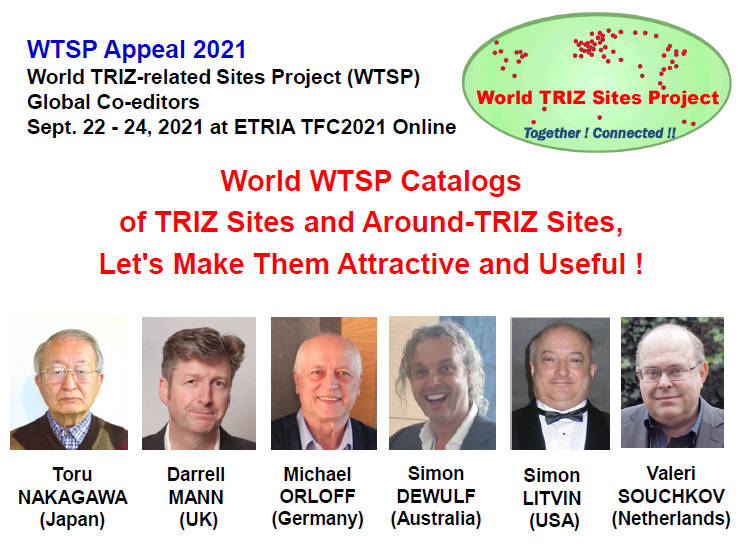
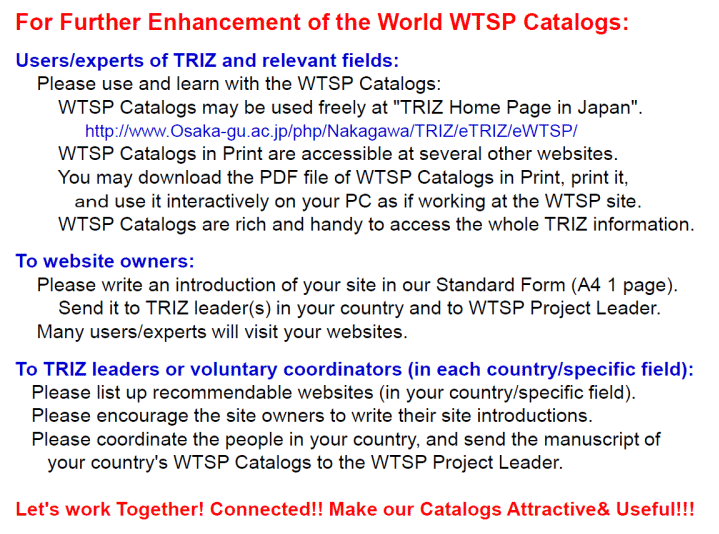
The World TRIZ-related Site Project (WTSP) posted the Catalog manuscripts contributed from Taiwan and South Korea since last Nov., but has been inactive since Jun. this year, unfortunately. For the policy and full history of the WTSP project activities, please refer to the WTSP project index page . The full set of documents created by WTSP is publicly available through the World WTSP Catalog Top Page (and for further details, the World TRIZ Site Catalogd (A) , the World Around-TRIZ Site Catalogs (C) ). The latest report of this project is the paper and presentation video at the ETRIA TFC 2023 . The parts still incomplete are the catalogs of TRIZ sites in major TRIZ countries (France, Germany, Italy, the Netherlands, etc.). I hope that one day the World TRIZ-related Site Catalogs will be completed with these by the contribution of each coountry catalog. |
|



|
Believing that research into Short-term/Imminent Earthquake Prediction is important for Japan (and the world), I joined the Earthquake Prediction Society of Japan (EPSJ) in early 2015. At the end of 2022, I learned that "a major clue to earthquake prediction (EQP) had been obtained", and I began to support EQP research within EPSJ. On this website I have built an index page for "Earthquake Prediction Research and Disaster Prevention (Mitigation)" (Jun. 2023). I have made a presentation at EPSJ (Dec. 2023), written a series of introductory articles on LinkedIn (Apr. 2024 -), made presentations at Japan TRIZ Symposium (Aug.. 2024) and at the ETRIA TFC-TRAI (under construction) (Nov. 2024).
As the Kamiyama method and the Tsutsui method have each achieved excellent results, we should start research projects within EPSJ by multiple research groups to confirm the effectiveness of each method. I am going to devote myself to support and promote the EQP research toward practical/official application, with the hope of reducing the damage caused by earthquakes in Japan (and the world), hopefully in 20 years. I will use this "TRIZ Home Page in Japan" for this purpose as well as the TRIZ method and the WTSP project. I ask for your understanding and support.
Earthquake Prediction (EQP) Research Based on the TRIZ Philosophy: (5) Kamiyama Method: Observing Crustal Strains using GNSS Data (Toru Nakagawa) (LinkedIn, Oct. 3, 2024 ) (THPJ, Oct. 7, 2024 ) (THPJ, Oct. 7, 2024 )
| |
Makoto Kamiyama (Professor Emeritus, Tohoku Institute of Technology) et al. presented a paper at the EPSJ (Earthquake Prediction Society of Japan) Conference in Dec. 2023. They use the precise location data of about 1300 reference points throughout Japan, which are measured and updated daily by the Geospatial Information Authority of Japan using the DNSS satellite. Kamiyama et al. use the triangular FEM mesh to derive the maximum shear strain and the area strain (dilatation) coefficients for each triangular area. Detailed data and their analysis are reported for Hokkaido Iburi East EQ (Sept. 6, 2018, MJ 6.5). The dilatation coefficients of four triangle areas around the epicenter are plotted daily against the time axis from 2011 to 2023. The four areas initially shrank slowly at the same rate, then at the EQ two areas suddenly expanded, and after the EQ all the four areas shrank slowly again as before. Zooming in to the year 2018, anomalous variations of the dilatation coefficients suddenly appear 3 months before the EQ. Two areas vary positively while two others vary negatively; but, regardless of the direction, the variation patterns are very similar. The variation started to increase 3 months before the EQ, reached its peak, and slowly decreased in an unstable manner, then changed suddenly at the EQ, and disappeared a few days after the EQ. |
|

Click to enlarge
(Note: A different fugure was posted here by mistake from Oct. 7 to 14. Revised on Oct. 14, 2024.) |
Similar abnormal pre-EQ variations were observed in all 3 EQs in the paper. Using these precursors, we can estimate the seismic region and magnitude of the coming EQ on the basis of number and extent of areas showing such abnormal variations. As for the timing of the coming EQ, we learn the cases of 3 years to 3 months, but have not yet found any further indicators of the occurance of EQs.
The Kamiyama Method is now considered the most useful and promising for Short-term EQ Prediction. We should observe and analyze many more EQs to refine the method.
Short-term Earthquake Prediction Research Based on the TRIZ Philosophy (Toru Nakagawa) (Presented at Japan TRIZ Symposium 2024 on Aug. 29, 2024) (THPJ, Sept.5, 2024 ) (THPJ, Sept. 5, 2024 )
| |
I presented this paper a week ago at Japan TRIZ Symposium 2024 held by NPO Japan TRIZ Society.
I am trying to discuss and propose on "Earthquake Prediction Research" in a general and systematic manner as a scientist (not specialized in seismology) who learned the creative problem-solving metodology, especially TRIZ. To present this paper at the TRIZ community, I included the phrase "Based on the TRIZ philosophy" in the title and it is the core of uniquness of this paper among many seismological papers and reviews. I am happy if you could read it about "Research on Earthquake Prediction" regardless of TRIZ.
I am discussing on : the purpose, the background, the way out of the groping in the dark, the introduction of an epoch-making observation result (by Minoru Tsutsui), considerations and proposals for future development, the construction of a technical system for earthquake prediction, and a vision for official launching of earthquake prediction warnings/emergency alerts. |
|

Click to enlarge
|
The following documents are posted: In the English page : Abstract (.html) , Slides (21 slides, .pdf, 1.4 MB) .
In the
Japanes page : Abstract (.html), Presentaation slides (21 slides, .pdf, 1.2 MB) , Presntation slides with annotation (.html) ; Presentation video (.mp4, 23.5 min., 568 MB) 
Earthquake Prediction (EQP) Research Based on the TRIZ Philosophy: (4) Tsutsui Method: Observing Underground DC Electric Field (Toru Nakagawa) (LinkedIn, Aug. 13, 2024 ) (THPJ, Aug. 31, 2024 ) (THPJ, Aug. 31, 2024 )
| |
In this 4th Part, I am introducing you to the excellent EQ Prediction method reported by Minoru Tsutsui at the EPSJ Conference in Dec. 2022. He observed, deep under the ground at a remote site, the DC electric field transmitted directly from the epicenter region without passing through the noisy surface regions. He set a dipole DC sensor (100 m long) in a 150 m deep borehole and detected the siignal, passing it through a preamplifier, filters, etc., at every second and stored it in a PC. In the case he observe on May 1, 2021, the signal was quiet at first with small noise, and at 8:50 a drastic variation (with S/N > 30) occured for 46 minutes, then stayed clam. At 10:27, there was a pulse-like signal, followed by another period of calm. At 19:00 another drastic variation occured for 68 min. and remained calm. He learned later at the official EQ records that exactly at 10;27 there was an EQ of M6.8 off Miyagi (about 750 km away). Accordingly he assigns the first drastic variation as the precursor and the second (most probably) as the "post-cursor" of the M6.8 EQ. |
|

Click to enlarge
|
This is an epoch-making observatin of the EQ precursor with high S/N, drastic fine structure, 1-sec time resolution, and 1.5 hours before an EQ occured in a distant location. The correlation with the EQ is clear, and the signal contains rich information about the EQ process, which remains mysterious.
I am proposing that we initiate a collaborative research project within EPSJ to support and develop the Tsutsui Method further. We should advance from the current one-site stage to the multiple-site stage, and then to the nation-wide network stage of EQ prediction (in terms of where, when, and what size) based on the Tsutsui Method. (We should integrate other EQ prediction methods and gain the understanding and approval of the academic, social, and governmental communities before officially launching the EQ Prediction Alert system.)
Earthquake Prediction (EQP) Research Based on the TRIZ Philosophy: (3) For Selecting "Promising Precursor Phenomena" (Toru Nakagawa) (LinkedIn, Jul. 6, 2024 ) (THPJ, Jul. 15, 2024 ) (THPJ, Jul. 21, 2024 )
| |
In current seismology, the physical conditions of various earthquakes (EQs) are not yet known, and thus the timing, process, and associated phenomena of destruction, i.e. the EQ, are not predictable. Therefore, research on short-term EQ prediction should follow the approach of "experimental science," which involves searching for possible precursor phenomena, selecting promising ones, and developing prediction methods by observing and analyzing the phenomena. We are now proceeding to the selection and development stage. The figure shows how we select precursor phenomena.
The first category is the mechanical phenomena. They include relative crustal motion, pressure, strain, etc., but they change too slowly to predict when the destruction will suddenly occur . Changes in the moving rate have been observed prior to EQs through analysis of geodetic satellite data (by Kamiyama et al.). |
|

Click to enlarge
|
The second category are electromagnetic phenomena. They are generated as a secondary effect, but can be observed with high sensitivity by various methods; this is a well-known advantage of electromagnetic technology over mechanical ones. Various experiments have been carried out on the ground to observe electric fields, electromagnetic waves of different frequencies, radio waves reflected in the ionosphere, etc., but none of them was successful due to interference from various natural and artificial noises on the ground and in the sky.
The data of TEC (total electron content) in the ionosphere observed by GNSS satellite were analyzed by K. Heki to show an increase for a few hours before and after EQs. This method may be applicable to predict imminent large EQs on a global scale in the future.
M. Tsutsui observed the vertical electric field deep underground to detect drastic variations from a few hours before to several hours after an EQ. He obtained a continuous record of every second for an EQ (750 km distant, M6.8) with the S/N ratio over 30 and drastic fine structure. This method is epoch-making to clearly show the possibility of imminent EQ prediction inthe future.
Earthquake Prediction (EQP) Research Based on the TRIZ Philosophy: (2) Requirements of Precursors for Short-term EQ Prediction (Toru Nakagawa) (LinkedIn, May14, 2024 ) (THPJ, Jul. 15, 2024 ) (THPJ, Jul. 21, 2024 )
| |
Fundamental requirements: X is related with and caused by EQs, occurs short time before for various types of EQs, ...
==> Can examine only after extensive observation and analysis.
Basic Req.: Observable/measurable clearly with high S/N ratio.
==> Need to develop measurement method/instrument (at one site)
Confirmation Req.: Observable at multiple sites similarly, for many EQs, confirming occurrence of EQs just as predicted.
==> Data accumulation at multiple sites to confirm correlation with EQs
Practical Req.: Automatic/stable/continuous measurement, and methods for predicting EQs (where, when, magnitude)
==> Reliable technical system and thorough analysis of experimental data
Advanced Req.: System integration and proving causality with EQs.
==> Need advanced research in seismology, esp. the EQ process.
Social Req.: Reliable operation of short-term EQ prediction/alert system.
==> Need recognition/approval by academia, society, government, etc. |
|

Click to enlarge
|
Earthquake Prediction (EQP) Research Based on the TRIZ Philosophy: (1) Why and How I Decided to Work on this Difficult Topic (Toru Nakagawa) (LinkedIn, Apr. 27, 2024 ) (THPJ, Jul. 15, 2024 ) (THPJ, Jul. 21, 2024 )
| |
Great Earthquake (EQ) Disasters in Japan: e.g., Tokyo (1923), Kobe (1995), East-Japan (2011).
Much advanced seismological study with extensive networks of seismometers. Long-/mid-term probabilistic foreseeing of possible EQs in all areas of Japan, but the 1995 (Mw 6.9) and 2011 (Mw 9.1) EQs were never predicted.
Seismological Society of Japan (SSJ) and Government decline the research on short-term EQ prediction regarding it impossible at the present stage.
Earthquake Prediction Society of Japan (EPSJ), founded in 2014, pursues EQ precursors with a new approach that emphasizes electromagnetic phenomena.
In Dec. 2022, M. Tsutsui reported an amazing observation of drastic fluctuations of DC electric field under the ground just before and after an EQ (750 km away. M 6.8). The data are clear with S/N over 30 and time resolution of 1 sec.
We should prove the correlation (and causality) with EQs, and establish a method to estimate where, when and how large the predicted EQ will be.
I propose a research project to observe the signals at multiple locations in parallel.
We will proceed further to build a technical (and social/official) system with several tens of observation sites all over Japan and announce imminent EQ prediction alerts in future. |
|

Click to enlarge
|
EQP Forum: "Earthquake Prediction Research: Readers' Forum (2024)" is now open. (Toru Nakagawa) (Jul. 21, 2024)
A new page is open where various opinions, questions, and contributions from readers (of course including those who are involved in earthquake (prediction) research). Please feel free to send us your comments, questions, contributions, etc. either in English or in Japanese.
 Nakagawa's activity plan: Presentation and introduction on "Earthquake Prediction Research Based on the TRIZ Philosophy" (Toru Nakagawa) (Jul. 21, 2024)
I am making efforts to present my ideas in as many forums as possible, hoping to gain the understanding and cooperation of many people. Including:
(A) Posting my presentation at EPSJ 2023 here on "TRIZ HP Japan" (Dec. 25, 2023). Japanese paper, slides, and video.
(B) Posting a series of inroductory articles, on LinkedIn in English (continuing some more) (Apr. 27, May 14, Jul 6, 2024). Posting the English versions here on "TRIZ HP Japan", and also Japanese translation versions.
(C) Submitted a paper to the ETRIA TFC-TRAI2024 (to be held in Romania, Nov. 6-8, 2024) in English (Jun. 4, 2024).
(D) Submitted a presentation to Japan TRIZ Symposium (to be held in Tokyo, Aug. 29-30), slides in Japanese and in English together (Jul. 11, 2024).
WTSP: Manuscript (Stage (3a)) of South Korea Part of World WTSP Catalogs (TRIZ Sites) (Min-Gyu Lee) (May 15 2024)
The Manjuscrpt (at Stage (3a) of South Korea Part of World WTSP Catalogs (TRIZ Sites) has been contributed by Min-Gyu Lee, the Country Editor, on May 14, 2026 and revised slightly on May 14, 2024. Preparation history, Index table, and Site descriptions are posted together in an HTML page. It includes: ◎ (or ◎) 4 sites, ○ (or ○□) 11 sites, □ 8 sites, and △ 3 sites. All the sites are introduced in a simple format. Top 9 sites are:
KR-01 ◎ ; Korean TRIZ Association (KTA) ; http://www.triz.or.kr ; a corporation, aims to continuously research and develop, create and share theories and cases so that many people can use TRIZ usefully for the development of the world centered on Korea.
KR-02 ◎ ; Korea Society for Creativity and Application (KOSCA) ; http://www.kosca.net ; An incorporated corporation, aims to activate research and utilization of TRIZ, creativity and design techniques in industry, academia, and the public sector, operates a practical academic society, publishes a journal, and supports exchanges between fields and among domestic and foreign participants.
KR-06 ◎L ; Google Scholar (Search TRIZ+Korea) ; https://scholar.google.co.kr/ ; 3690 scientific articles written mainly in English can be found if you search 'TRIZ+Korea' in Google Scholar site as of Apr 2024
KR-07 ◎ ; Research Information Service System (RISS) <Search TRIZ or 트리즈> ; https://www.riss.kr/index.do ; 2299 academic articles or books etc can be found if you search 'TRIZ' here as of Apr 2024. 798 items can be fouund if you search '트리즈'.
KR-04 ○ ; Korea Invention Promotion Association (KIPA) ; http://www.kipa.org ; A public institution to promote Inventions and IP industry. KIPA has been operating the largest program for supporting product innovation of small and medium companies using "OPIS" methodology based on FOS of TRIZ since 2013.
KR-05 ○ ; Idearo ; https://www.ipmarket.or.kr/idearo/index.do ; A platform for paid idea contests and idea trading. Idearo platform is operated by the Korean government organizations, KIPA (Korea Invention Promotion Association) and KIPO (Korean Intellectual Property Office).
KR-08 ○ ; Kyobo Book Center (Search TRIZ or 트리즈) ; https://www.kyobobook.co.kr/ ; One of the largest online book store in Korea. 253 books (including 63 ebooks) can be found if you search TRIZ here as of Apr 2024.
KR-20 ○ ; TRIZ Solver ; http://triz-solver.com/ ; Russian ; Home page of TRIZ Master Dr. Yury Danilovsky who has been consulting in South Korea since 2009
eEQP: Earthquake Prediction Research and Disaster Mitigation (EQP): eEQP Index Page Is Now Started (for the 3rd Time) (Toru Nakagawa) (Feb. 18, 2024) (Dec. 12, 2023)
Reconfirming the importance of the issue "Earthquake Prediction Research and Disaster Mitigation (EQP)", I have decided to set the theme as one of the important pillars of this website "TRIZ Home Page in Japan". In the Japanese pages, I made the new folder jEQP directly under the website home and started the jEQP-index page on Dec. 12, 2023. In the English pages, I have just started the eEQP folder and eEQP-index page today, Feb. 18, 2024.
Posting in English are delayed by 2 months, because I had to work hard to promote the EQP project in the Earthequake Prediction Society of Japan (EPSJ). Please allow me to post the EQP articles in this website mostly in Japanese, and only in a simplified way in English.
The EQP articles posted in Japanese during last 2 months (Dec 10, Dec. 12, Dec. 25, Jan. 4) are introducd in English translation (simplified) in the corresponding positions of date in this index page..
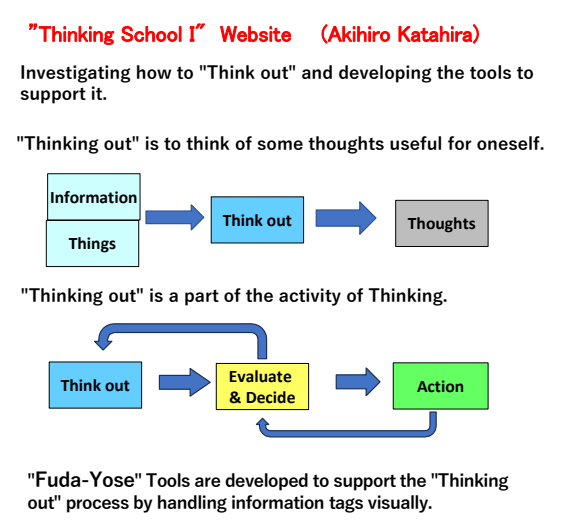
WTSP: Full Introduction of JP-24 □ "Thinking School 1" Site (Akihiro Katahira) (Jan. 30, 2024)
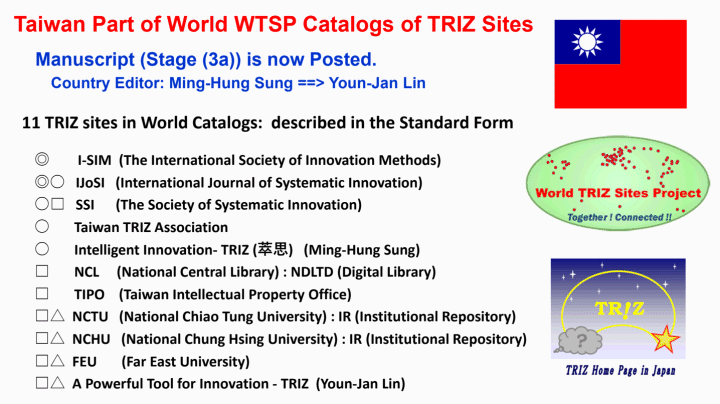
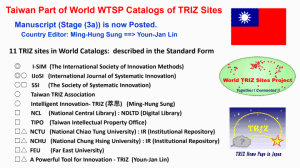
WTSP: Manuscript (Stage (3a)) of Taiwan Part of World WTSP Catalogs (Ming-Hung Sung, Youn-Jan Lin, Toru Nakagawa) (Jan. 30, 2024)
The Manjuscrpt (at Stage (3a), i.e., almost final to be submitted to the Project Leader) of Taiwan Part of World WTSP Catalogs is now ready and posted, by the Country Editor: Ming-Hung Sung and later Youn-Jan Lin. It includes 2 ◎ sites, 3 ○ sites, and 6 □ sites. All these 11 sites are described in the WTSP Standaed Form (b).
In addition, 19 sited are listed at the △ level, showing only the site names and URLs. Important 5 TRIZ websites in Taiwan are:
◎ I-SIM (The International Society of Innovation Methods) -- International non-profit organization based in Taiwan,
promoting TRIZ and innovation methods, conducting annual ICSI conference and GCSI competition, operating IJoSI in corporation with SSI,
providing full scales of international certifications of specialists in Technical/Management innovation and Patent Technical Analysis, etc. and accumulating TRIZ and SI documents,
◎○ IJoSI (International Journal of Systematic Innovation) -- Peer-reviewed international journal in the field of TRIZ and SI,
operated in collaboration with I-SIM.
○□ SSI (The Society of Systematic Innovation) -- Non-profit organization operating in Taiwan, for conferences, training, certification, etc.
in collaboration with I-SIM.
○ Taiwan TRIZ Association -- Non-profit organization based in Taiwan, associated with MATRIZ, having about 350 members, promoting TRIZ research and applications with training/conferences, etc.
○ Intelligent Innovation- TRIZ (萃思) (Ming-Hung Sung) -- Website built and operated by Prof. Ming-Hung Sung for publicly introducing TRIZ and its applications. |
|
Click to enlarge.
|
WTSP: Full site introduction of DE-03 ◎ MTRIZ site (Michael Orloff) is revised slightly (Jan. 30, 2024)
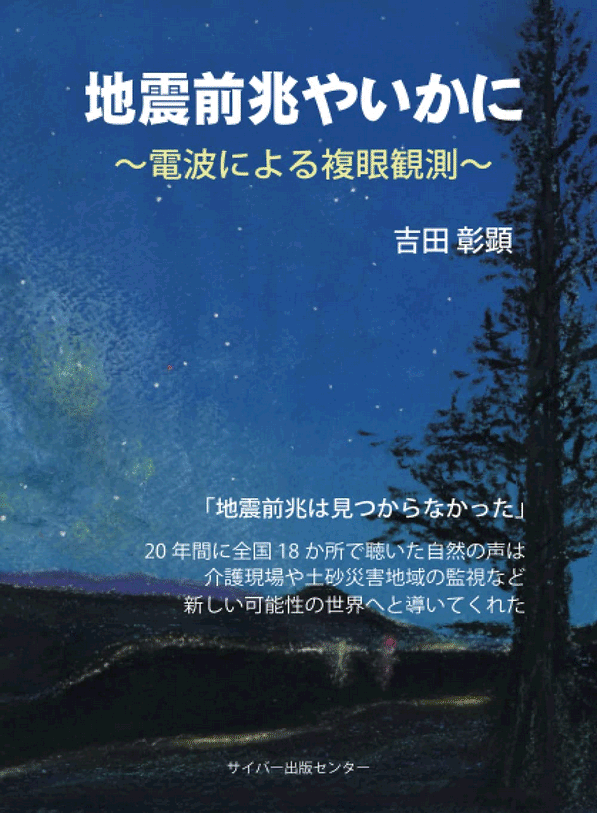
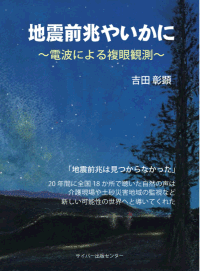
jEQP: Book Review: Teruaki Yoshida, "Can We Find Earthquake Precursors? - Multiple Perspective Observation with Radio Waves" (Published: Mar. 2016), Toru Nakagawa, Posted on Amazon site, Jan. 4, 2024)  (2024.1. 4)
Excellent research practice, detailed and clear presentation of real observation data, and impressive educational practices. -- However, other more direct observation methods are beginning to shed light on earthquake precursors.
The research aim of this book can be summarized as: "Using the fact that FM broadcast radio waves from out-of-sight are sometimes reflected by the ionosphere and reach us, we want to observe the effects of earthquakes on the ionosphere, find characteristic precursor phenomena, and create a method for short-term/imminent prediction of earthquakes."
After his intensive research from 1995 to 2012, the author concluded: "With the arrival of seismic tremors, broadband electromagnetic noise was often observed . However, no precursor phenomena related to the earthquake, such as ionospheric disturbances, could be detected."
-- I mention three new observation methods which have detected highly-possible EQ precursor phenomena. |
|
Click to enlarge
|
Posted in 2023
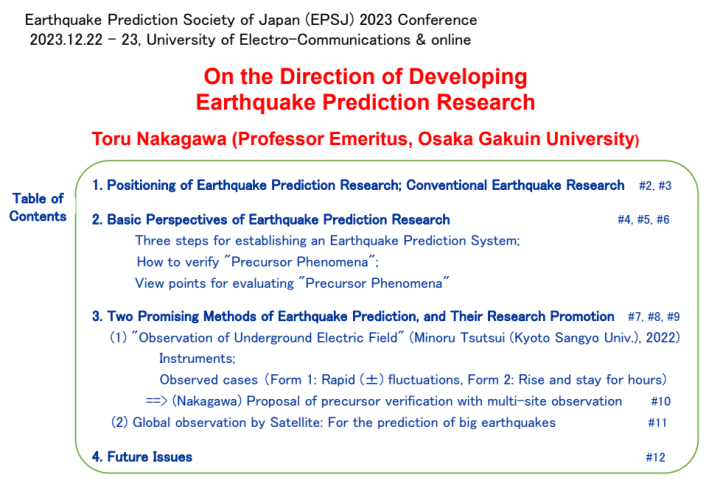
jEQP: On the Direction of Development of Earthquake Prediction Research (Toru Nakagawa, EPSJ Annual Conference, Dec. 22, 2023) (Dec. 25, 2023)
Based on the theory of plate tectonics, recent seismology has enabled long-/medium-term probabilistic forecasting of earthquakes (EQs), using the analysis of seismic motion with networks of seismographs and the analysis of crustal motion measured by geodetic satellites. But it avoids the research of short-term/imminent prediction of EQs, assuming that such prediction is currently impossible. However, most of the public wants to make the short-term/imminent EQ prediction possible to reduce the EQ disaster; and this desire is exactly the goal of the Earthquake Prediction Society of Japan (EPSJ).
The present paper discusses the methodology for realizing the goal. Our basic strategy is to capture the precursor phenomena. We take the approach of experimental science, relying on observations and experiments rather than theories, and we also focus on electromagnetic phenomena rather than mechanical phenomena. In particular, the present paper notes the observation of signals in the underground electric field by Minoru Tsutsui (2022) and therefore proposes to start a research project to verify the signals as EQ precursors by simultaneous observation at multiple sites and to establish a method for short-term/imminent prediction of EQs.
jEQP: Introducing the website of Earthquake Prediction Society of Japan (EPSJ) (Toru Nakagawa) (Dec. 10, 2023 - )
EPSJ Homepage: https://www.eqpsj.jp/index.html (in Japanese).
Links to its main pages are shown;
major activities and articles will be briefly introduced.
EPSJ Annual Conference 2023: December 22-23, 2023, Univ. of Electro-Communications & online (2023.12.11)
jEQP: Earthquake Prediction Research and Disaster Mitigation (jEQP-Index Page) (Toru Nakagawa) (Dec. 12, 2023)
Reconfirming the importance of the issue "Earthquake Prediction Research and Disaster Mitigation", I have decided to set this theme as one of the important pillars of this website "TRIZ Home Page in Japan". Accordingly, I have made the new folder jEQP directly under the website home, and have moved the TRIZ Forum: On Earthquake Prediction Research and Disaster Mitigation (3rd Index Page) to the new folder as its main index page. Main contents at present are:
(I)
On The East Japan Earthquake, Tsunami, and Nuclear Power Plants (Mar. 23, 2011, May 19, 2011)
(II) Introduction to the Research of Short-term (or Just-before) Prediction of Earthquakes by Use of Electromagnetic Phenomena: (Mar. 9, 2015)
(III) TRIZ Forum: On Earthquake Prediction Research and Disaster Mitigation (3rd Index Page) (Toru Nakagawa)  (Jun. 6, 2023)
==> Now reformed into the present page: 'Earthquake Prediction Research and Disaster Mitigation (eEQP-Index Page) (Dec. 12, 2023) (Feb. 18, 2024)
WTSP Forum: WTSP Communication Forum 2023 F (Nov. - Dec.) (Editor: Toru Nakagawa) (Nov. 27, 2023)
Announcements and Communications related to WTSP Activities are recorded here.
(Nov. 2023): 25th Anniversary of "TRIZ Home Page in Japan"  : On the 25th Anniversary (TN); 25th Anniversary (1998 – 2023) of "TRIZ Home Page in Japan" (Editor: Toru Nakagawa) : A Brief History of Development (TN, Posted in LinkedIn, Nov. 12)
Alexander T. Narbut (Ukraine) <==> TN: Contribution of an Archive paper: "From the Exchange of Inventions to the Exchange of Methods" (Narbut & Narbut, 1985) (Nov. 27, 2023)
TRIZ Archive: From the Exchange of Inventions to the Exchange of Methods (A. Narbut & N. Narbut, 1985): Q&A (TN and A. Narbut) (Nov. 27, 2023)
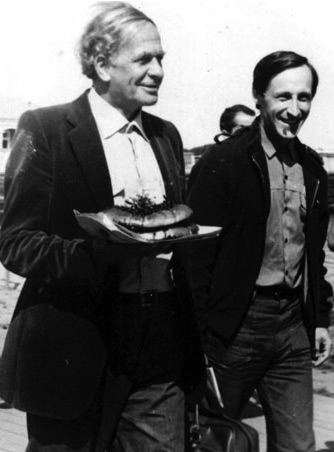
Alexander Theodor Narbut (Ukraine) has contributed to our site this paper which was originally presented at a WIPO Conference held in Burgaria in 1985.
I beleive the message "From the Exchange of Inventions to the Exchange of Methods (especially TRIZ)" is still valid even after nearly four decades.
On my 4 qustions, the Author replies thoroughy about the backgroud situations. This webpage contains: The Paper, Proceedings of the Conference (Foreword, Table of contents, and Narbut&Narbut Paper) (in .pdf), Q&A, and Selected communications between (Narbut and TN). |
|
G.S.Altshuller and A.T.Narbut.
Karelia (USSR), summer 1982.
|
25th Anniversary (1998 – 2023) of "TRIZ Home Page in Japan" (Editor: Toru Nakagawa) : A Brief History of Development (Nov. 12, 2023)
Posted on LinkedIn: https://lnkd.in/gaf7sUJK (Nov. 12, 2023)
The top figure shows a brief history of the Website "TRIZ Home Page in Japan ".
The figure is designed on the basis of my Site Introduction (2020) for the World WTSP Catalogs. See:
Best 4 Slides from My 21 Years of "TRIZ Home Page in Japan" (Feb. 2020)
Site Introduction (Features and Selected articles) of "TRIZ Home Page in Japan" for the World WTSP Catalogs. (Feb. 2020).
On the 25th Anniversary of "TRIZ Home Page in Japan": Toru Nakagawa (Nov. 9, 2023)
This Website "TRIZ Home in Japan" celebrated its 25th Anniversary on Nov. 1. It serves as an open forum of information exchange for better understanding and usage of Creative Problem Solving Methodologies. I am very grateful to you all, including authors, co-authors, translators, and readers in Japan and around the world, for your continuing support.
Last June I posted a Forum page "On Earthquake Prediction Research and Disaster Mitigation". Since this is a crucial issue in Japan, I have started to support a research project for earthquake prediction.
I wish this Home Page is useful for you readers to solve your various problems. Your contributions either in English or in Japanese are heartily welcome.
 WTSP: Preliminary Manuscripts of Country Parts of World WTSP Catalogs (A) Europe (Toru Nakagawa) (Oct. 22, 2023)
On the basis of the 4th-round Internet surveys , websites of individual countries are visited again to make preliminary manuscripts of country parts of World WTSP Catalogs. Here I show such manuscripts for the countries in Europe (6 of them at first). The manuscripts are shown in the "Unfinished Source Data Manuscripts" page (at the stage 2d); Main results are breifly summarized here.
Counry |
Numbet of websites
(TRIZ / Around-TRIZ) |
TRIZ Sites evaluated as □△ or higher |
Austria
|
TRIZ : 2 ○□, 2 □△;
Around : 2 ○□, 1 □、1 □△ |
○□ Jantschgi C&R,
○□ Biognosis Blog & Tools (by Elke Barbara Bachler),
□△ PfI (Platform for Innovation),
□△ Tritium (by Harald Graf-Müller) |
Czech Republic
|
TRIZ : 2 ○□, 2 □, 2△;
Around : 2 ○□, 2 □, 2△ |
○□ TRIZing (by Bohuslav Bušov),
○□L ICG (Integrated Consulting Group),
□ TUL (Technical University of Liberec) : Digital Repository,
□△ BUT (Bruno University of Technology) :Digital Library. |
Finland
|
TRIZ : 3 □;
Around : 1 ○□, 2 □. |
□ LUT University (Lappeenranta-Lahti University of Technology LUT),
□ QKK (Quality Knowhow Karjalainen),
□ Viima |
Greece
|
TRIZ : 1 □;
Around : 1 ○□, 1 □. |
□ ATINER (Athens Institute for Education & Research) |
Hungary
|
TRIZ : 2△;
Around : 3□, 1 △. |
(△ Lean Six Sigma Consulting),
(△ SMARTii (Smart Innovation Institute Ltd.) ) |
Ireland
|
TRIZ : 1□, 1△;
Around : 2○□, 2 □. |
□ IJEE (International Journal of Engineering Education) |
I am going to work for many more countries one by one, but only very slowly in spite of my desire. We wish that TRIZ colleagues in every country in the world to build and improve such preliminary manuscripts and contribute to complete the World WTSP Catalogs in a year or two.
Editorial: "TRIZ Home Page in Japan" : Postings in LinkedIn 2023 (Toru Nakagawa,) (Sept. 21, 2023)
This page intends to be a short summary of "TRIZ Home Page in Japan" (especailly English pages), by using (mainly) the articles posted in LinkedIn. I have been posting short articles in LinkedIn more or less regularly every two weeks or so to promote especially the WTSP project towards a much wider audience interested in TRIZ and Innovation. Series of my postings in LinkedIn is accessible openly via https://www.linkedin.com/in/toru-nakagawa-b2453216/recent-activity/all/ . It now has 14 postings.
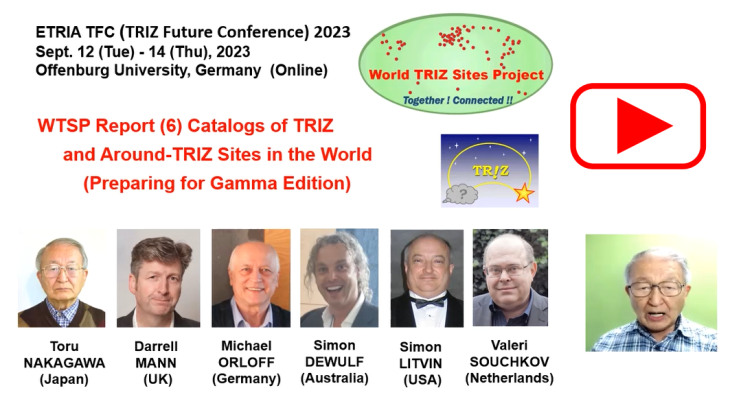
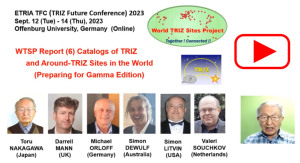
WTSP Paper (ETRIA): WTSP Report (6) Catalogs of TRIZ and Around-TRIZ Sites in the World (Preparing for Gamma Edition) (Toru Nakagawa, Darrell Mann, Michaael Orloff, Simon Dewulf, Simon Litvin, Valeri Souchkov) (Sept. 18; Sept. 26, 2023)
This paper was presented at ETRIA TFC2023 (held Online at Offennburg Univ. (Germany), on Sept. 12-14). The paper (17 pages) is published in the Proceeding (by Springer) and accessible through https://doi.org/10.1007/978-3-031-42532-5_34 . We post here the paper in HTML , the presentation slides (15 slides, in HTML and in PDF ) and the presentation video (in MP4, 15 slides, 11m12s) .
In the Japanese page , the full paper in Japanese translation is now posted, in respect to the importance of this paper. (Sept. 26, 2023)
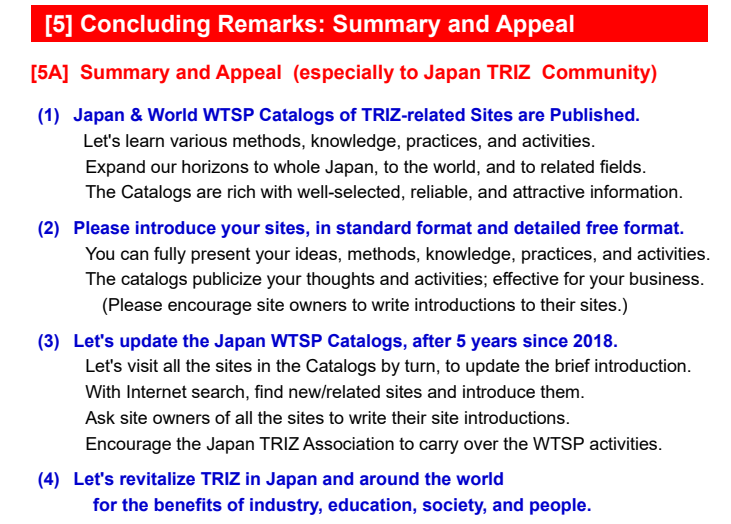
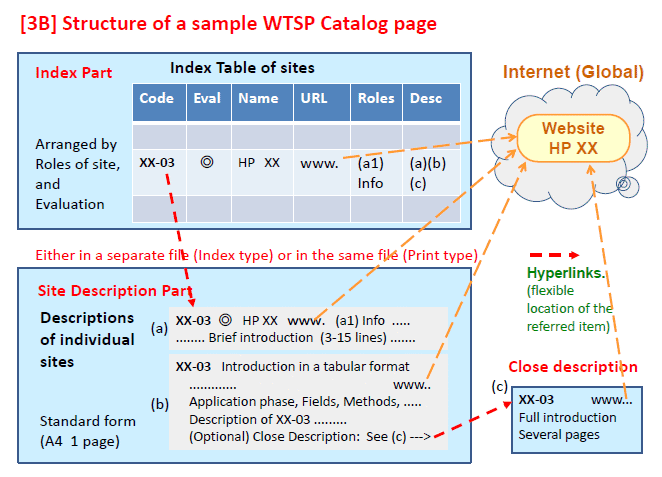
The WTSP project has been working to create Catalogs of TRIZ-related Websites in the world. The paper describs its vision/significance/goals and the structure and current version of the Catalogs. Even though the World Catalogs of Around-TRIZ Websites are already compiled/published reasonably well, the World Catalogs of TRIZ Websites are insufficient due to lack of contributions from many countries. Our difficulty has been "Many people support the project, but very few of them actually work to build the Catalogs". An apparent reason is "the talented people in TRIZ are always too busy in their jobs to work voluntarily for WTSP". The hidden core reason, we have recently found, is that many TRIZ people have not seen the completed Catalogs and hence do not recognize possible Values of the Catalogs and who and how to create such Values. The Values of the WTSP Catalogs depend on a person's position. For site owners, it is the opportunity to introduce their sites to the world; for TRIZ leaders/experts/practitioners, it is the overview of the (methodical) development and activities of TRIZ (and related methods); for TRIZ users/learners, it is a reliable and comprehensible information source for learning and using TRIZ. These Values can be created by TRIZ leaders/experts/practitioners (including site owners) all over the world. Based on this recognition, we are going to rebuild the WTSP project to expand and enrich the World Catalogs of TRIZ Sites. We sincerely ask many TRIZ professionals in the world for their active collaboration. |
|
Click to enlarge.

Click to start the video (11m12s)
|
WTSP Paper (JTS): WTSP Report (6) Catalogs of TRIZ and Around-TRIZ Sites in the World: Let's Enhance the Japan WTSP Catalogs "Useful and Attractive" (Toru Nakagawa, Darrell Mann, Michaael Orloff, SImon Dewulf, Simon Litvin, Valeri Souchkov) (Sept. 18, 2023)
WTSP Forum: WTSP Communication Forum 2023 E (Sept. - Oct.) (Editor: Toru Nakagawa) (Sept. 10; Oct. 9, 2023)
(Sept. 2023): "Preliminary Manuscript of MENA Arabic Region of World WTSP Catalogs" is made open as a Not-yet finished Manuscript (at the Stage 2a) .
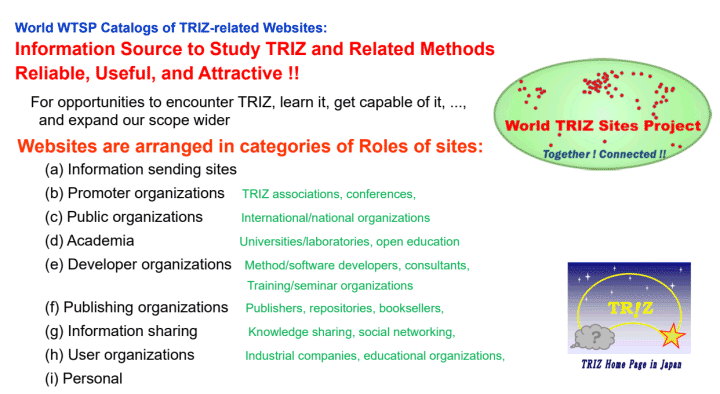
Posting in LinkedIn: "World WTSP Catalogs:�Information Source to Study TRIZ and Related Methods:�Reliable, Useful, and Attractive !! " (TN, Sept. 6, 2023) . There are various opprotunities for people to encoulter TRIZ, learn it, get capable of it, and expand our scope of it further. World WTSP Catalogs deliver you the information of many excellent websites that can support you at whatever such opportunities, especially because all the websites are arranged in the categories of Roles of sites. (Sept. 10, 2023) |
|
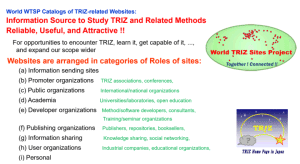
Click to enlarge.
|
"WTSP Report (6) Catalogs of TRIZ and Around-TRIZ Sites in the World" was presented at Japan TRIZ Symposium (Aug. 31, 2023) and at ETRIA TFC (Sept. 14, 2023). These presentations (Paper, Slides, and Video) are posted in the "TRIZ Home Page in Japan" and are announced in several forms, including (a) Update Announcement of THPJ to Japanese readers (about 200) and to THPJ readers over the world (about 200), (b) [WTSP] Letter to TRIZ leaders and WTSP members over the world (about 200), and (c) LinkedIn posting (open audience). These announcements are recorded in this Forum page; these presentation and announcement have the same core information but are adjusted differently towards the audiences/recipients. (Sept. 18 - Oct. 3, 2023).
Considering the much wider audience in LinkedIn, I have been posting articles about THPJ and WTSP every 2 weeks or so. A list of my series of LinkedIn postings is made and shown in . (Sept. 21, 2023)
(Oct. 2023) On the basis of the 4th-round Internet surveys , websites of individual countries are visited again to make preliminary manuscripts of country parts of World WTSP Catalogs. Here I show such manuscripts for the countries in Europe (6 of them at first). i.e., Austria, Czech Rep., Finland, Greece, Hungary, Ireland.
WTSP Forum: WTSP Communication Forum 2023 D (Jul. - Aug.) (Editor: Toru Nakagawa) (Jul. 1; Jul. 22; Aug. 13, 2023)
Jul. 2023: We submitted our Final Paper to ETRIA TFC2023. The paper writes our efforts for overcoming our difficulty: "Many TRIZ colleagues support the WTSP Project, but very few of them actually work to build the World WTSP Catalogs".
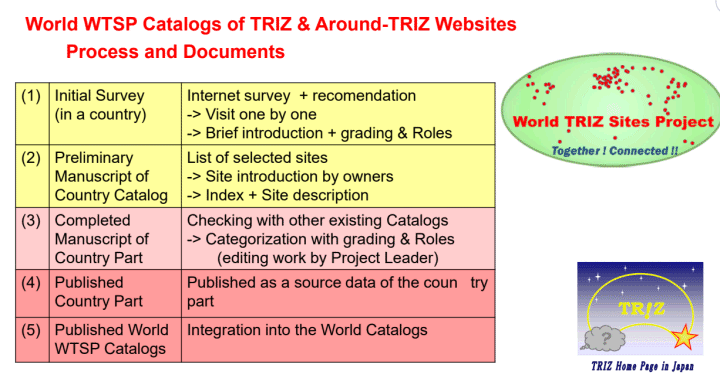
I have started a new series of postings in LinkedIn. The first is:" World WTSP Catalogs: Preparation Process and Documents" . See the PDF file . (Jul. 1, 2023) |
|
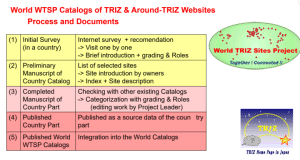
Click to enlarge.
|
Preparation of Taiwan Part
is proceeding by Ming-Hung Sung and its Preliminary manuscript is now registered in the Unfinished manuscript folder.
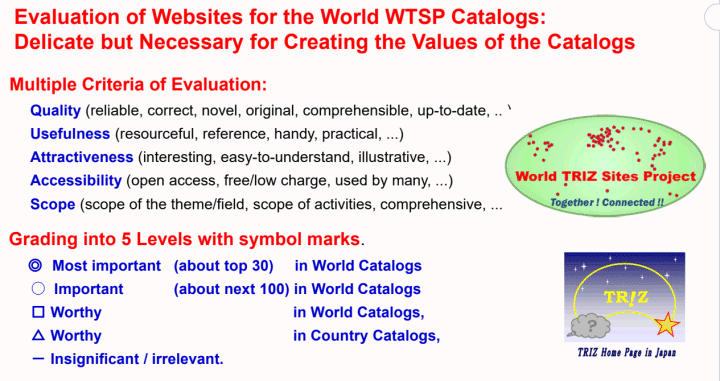
A new posting in LinkedIn: "Evaluation of Websites for the World WTSP Catalogs: Delicate but Necessary for Creating the Values of the Catalogs" . This is the most delicate and critical issue in our WTSP project (Jul. 22, 2023).
Preparation of Sweden and Norway Parts is going to start by Kent Hall (Norway). (Aug. 7, 2023) |
|
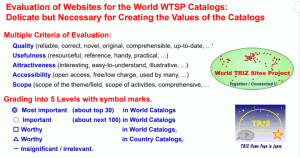
Click to enlarge. |
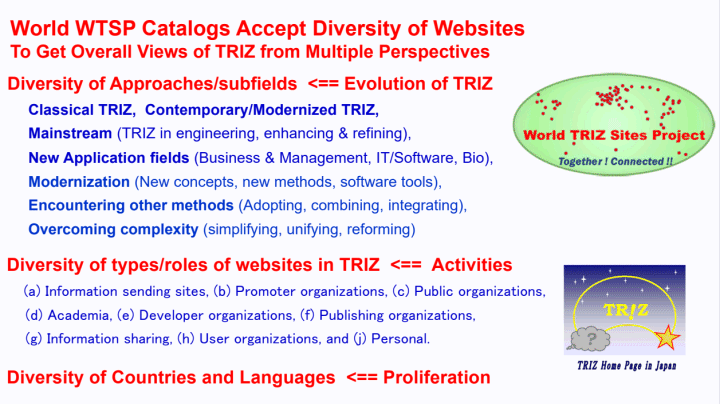
| (Aug. 2023) A new posting in LinkedIn: "World WTSP Catalogs Accept Diversity of Websites To Get Overall Views of TRIZ from Multiple Perspectives" . Our Catalogs have a general policy to accept the Diversities in TRIZ websites: Diversity of approaches/submethods of TRIZ (reflecting Evolution of TRIZ), Diversity of types/roles of websites (reflecting various acivities of TRIZ), and Diversity of countries and languages of websites (reflecting proliferation of TRIZ). This policy contributes to collect a full range of TRIZ-related websites for making overall views of TRIZ, and enhances the Usefulness of the World WTSP Catalogs.
|
|
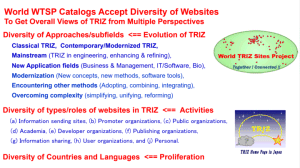
Click to enlarge. |
| |
| |
| The survey results of 15 websites in the MENA (Middle East & North Africa) Arabic Region were obtained and contributed by Khaled Shoaib (Egypt), the WTSP MENA Region Editor, on Aug. 28, 2023 . Using his data in a big table in .docx, Nakagawa set up a webpage in the form of Manuscript of MENA Part of World WTSP Catalogs; especially, consisting of (simpler) Index Part and Site Description Part (Sept. 1, 2023) . |
WTSP: World WTSP Catalogs: Unfinished Source Data Manuscripts (Index Page) (Toru Nakagawa) (Jun. 19, 2023)
Before being published in the World WTSP Catalogs, individual manuscripts (e.g., for a country or a SIG) must go through the following 5 Stages: (1) Initial survey stage, (2) Preliminary manuscript stage, (3) Completed manuscript stage, (4) Published source data stage, (5) Published World Catalog stage. Stages (1)(2) are carried out by country/SIG teams, while stages (3)(4)(5) are caried out by the Prolject Leader (TN). Manuscripts at various stages are received by TN from countries/SIGs and are openly posted (or just mentioned) on this WTSP site as a basis of further improvement.
This new page lists such unfinished manuscrpts which are unfinished at Stages (1) to (5) for the purpose of recording without loss/missing, making access easier, and encouraging further preparation/improvement of the manuscripts.
It currently lists: Internet surveys of 52 individual countries (Stage (1a)), Summary of Internet surveys of 40 countries (Stage (1b)); Preliminary manuscrit of websites in Korea (Stage (2b)), Partial & preliminary manuscripts of websites in Taiwan (Stage (2a)), Revised manuscript of websites in Russian-language region (Stage (3a)), Completed manuscript of websites in UK (Stages (4a)(4b)), Completed manuscript of websites in Germany (Stages (4a)(4b)), Completed revised manuscript of websites in Malaysia (Stage (4b)).
WTSP: Update of (A2) WTSP Organization and List of Members (Toru Nakagawa) (Jun. 19, 2023)
The page '(A2) Organization of WTSP' has been updated. The list of Members includes 94 people from 33 different countries. About 40 of them have submitted the Membership Application Form, while others have explicitly expressed thier will to join WTSP but have not yet submitted the Application Form, We have sent our [WTSP] Letters to about 200 people around the world since the start of the project. So there are many TRIZ leaders and colleagues who are not listed in the table, but who support the WTSP project. If you want to contribute to the WTSP, please contact the Country Editor of your country or one of other WTSP leaders shown here.
TRIZ Forum: On Earthquake Prediction Research and Disaster Mitigation (3rd Index Page) (Toru Nakagawa) (Jun. 6, 2023)
"Earthquake prediction research" is an exceptional topic for this "TRIZ Home Page in Japan". In 2011, right after the Great East Japan Earthquake (earthquake, tsunami and nuclear power plant accident), I sent e-mail messages to our readers around the world and received sympathetic and encouraging messages from more than 100 people from over 30 countries . Since then, the issues of earthquake prediction and disaster mitigation have become increasingly serious in Japan. In 2015, I joined the Earthquake Prediction Society of Japan and started a Forum page on my website to showcase earthquake prediction research . However, the forum has not been active for these 8 years because it was difficult for me as a non-professional to decide what and how to introduce. The issues are now much more demanding in Japan due to the high risk of large earthquakes in the near future. Therefore, I am now starting the Forum on Earthquake Prediction Research , for the 3rd time.
Today, I am posting my reviews of two excellent books on earthquake prediction research in Japan.
(1) "Earthquake Prediction: Development and Prospects" by Tsuneharu Rikitake (Japan Professional Books Publishing, Jan. 2001, 617 pages), review by Toru Nakagawa (Apr. 20, 2015, posted on Amazon website) .
A complete compilation of earthquake prediction research up to the year 2000. An excellent book, professional yet easy to read for everyone.
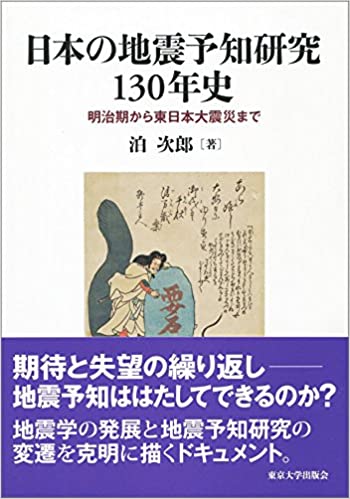
(2) "130 Years of Earthquake Prediction Research in Japan: From the Meiji Era to the Great East Japan Earthquake" by Jiro Tomari (University of Tokyo Press, May 2015, 686 pages), review by Toru Nakagawa (Jun. 2, 2023, posted on Amazon website).
|
An excellent work for earthquake researchers, disaster prevention and government officials, and all citizens who want to mitigate earthquake disasters.
This book was published 8 years ago, but I did not know about it and just read it for the first time. I am very impressed with the book and I regret that I have not widely surveyed good references. It is an excellent reference that contains a wealth of technical and social information that is much to learn. The book is so rich and dense that we cannot make a short summary. Here I will write what I learned and thought from the book: |
|
 |
The goals of earthquake research are prediction and mitigation, which form two wheels of a cart.
There are three approaches to earthquake prediction:
Prediction based on data from a large number of past seismic events (which has contributed to long/medium-term prediction); prediction based on some precursor phenomena; and prediction based on physical models.
For short/immediate term prediction, the use of "precursor phenomena" is most expected. But a number of objective criteria must be met to be accepted as "precursor phenomena", and none have yet been accepted as true "precursor phenomena". Even a foreshock earthquake cannot be called a "precursor" because it cannot predict whether or not a larger earthquake will soon follow.
Because of the diversity of earthquakes, we should not assume that there is a universal "precursor phenomenon" (applicable to any earthquake).
We must refer to the numerous previous studies and not be too optimistic (to meet the public's expectations).
However, we should still pursue the realization of "earthquake prediction" (as a science and for practical purposes).
Moving away from the conventional mechanical perspective (ground movement, pressure, strain, tremors, etc.), we should look for some electromagnetic precursor phenomena. This is an extremely difficult task that I believe we should pursue.
WTSP: MY-01 ◎ MyTRIZ (Malaysia TRIZ Innovation Association) (Toru Nakagawa) (LinkedIn) (May 7, 2023)
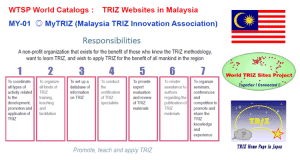
Eng Hoo Tan has submitted an update of the Index table of TRIZ Websites in Malaysia. It contains 1 ◎, 0 ○, 4 □ and 13 △ websites. The ◎ website is MY-01 MyTRIZ (Malaysia TRIZ Innovation Association) Official Website. Its Annual Report 2022 has also been submitted, and is set at the bottom of its full site description file. As vividly shown with many photos in its Annual Report, MyTRIZ is leading/promoting TRIZ in Malaysia with the close cooperation of industry, government agencies, and universities. It is the most active and successful TRIZ association in the world on a national/regional level. (This article has been posted on LinkedIn and recorded in our WTSP Forum.) |
|
Click to enlarge |
WTSP Forum: WTSP Communication Forum 2023 C (May - Jun.) (Editor: Toru Nakagawa) (May 7; Jun. 29, 2023)
Announcements and Communications related to WTSP Activities are recorded here.
May 2023: Index table of Malyasia
websites are updated. Especially the MY-01 ◎ MyTRIZ (Malaysia TRIZ Innovation Association) is introduced fully in the Catalog, and posted on LinkedIn. (May 7, 2023)
Jun. 2023: Please Help to Enhance the WTSP Catalogs of TRIZ Websites ([WTSP] Letter (34M-2))
Update
of (A2) WTSP Organization and List of Members ; World WTSP Catalogs: Unfinished Source Data Manuscripts (Index Page) ([WTSP] Letter (35M-1))
All the WTSP Catalog Data (published and under preparation) (Jun. 29, 2023)
WTSP: Please Help to Enhance the WTSP Catalogs of TRIZ Websites in the World (Toru Nakagawa) (LinkedIn) (Apr. 27, 2023)
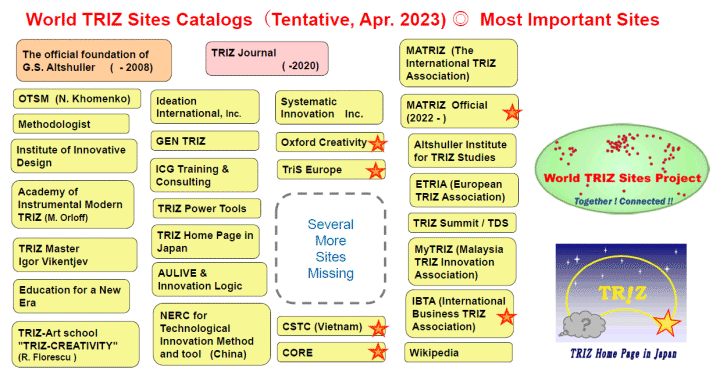
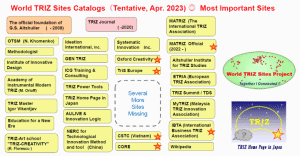
"Please Help to Enhance the WTSP Catalogs of TRIZ Websites in the World: Many Good Websites Are Still Missing in the Catalogs": We have just submitted our (draft) paper "WTSP Report (6)" to the ETRIA TFC2023. It is based on the recognition of the (possible) Values of the World WTSP Catalogs, as discussed in my LinkedIn article (Apr. 6, 2023). Recent activities to build the World TRIZ Sites Catalogs are briefly summarized, by showing the Most Important (◎) TRIZ Websites in the Top figure of this LinkedIn article. To the 23 sites in the Beta Edition (2020), we have added the 6 new sites shown with stars, but we are still missing several (about 10 ?) excellent sites from the current Catalogs. We would like youe help to make the World Catalogs of TRIZ Sites more "Useful and Attractive". |
|
Click to enlarge |
WTSP: Values of the World WTSP Catalogs (Toru Nakagawa) (LinkedIn) (Apr. 6, 2023)
"Values of the World WTSP Catalogs: for Site Owners, for TRIZ Experts, for TRIZ Users, and for TRIZ.
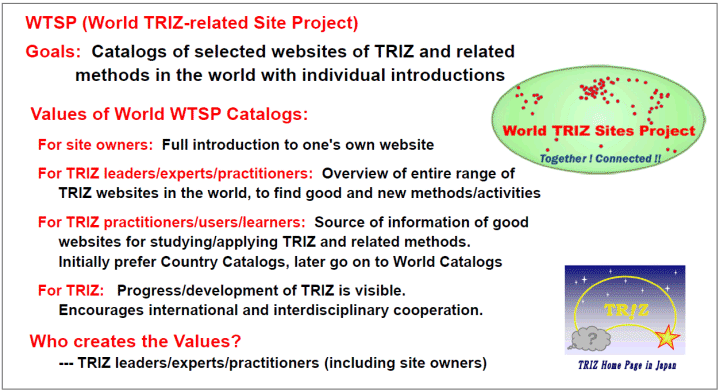
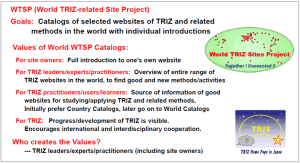
-- Who then Creates the Values?": Our WTSP project has a persistent difficulty: "Many TRIZ colleagues support the WTSP Project, but very few of them actually work to build the World WTSP Catalogs". The obvious reason is: "The talented people in TRIZ are always too busy in their business to do extra voluntary work". But we have recently realized the core of the hidden reasons is: "People do not yet recognize the (possible) Values ("Useful and Attractive") of the World WTSP Catalogs, because they have not yet really seen the Catalogs". In this short article I discuss the Values from 4 aspects and then on Who and How to create the Values. The discussion is summarized in the top figure of the LinkedIn article. |
|
Click to enlarge |
WTSP Forum: WTSP Communication Forum 2023B (Mar. - Apr.) (Editor: Toru Nakagawa) (Mar. 13; Mar. 22; Apr. 2; apr. 9; Apr. 29, 2023)
Announcements and Communications related to WTSP Activities are recorded here. In this News page, I will show them just briefly.
Mar. 2023: Reviewing Min-Gyu Lee's report and my reply (Feb. 19-20), I wrote a short article and post it on LinkedIn. "Great achievement with TRIZ, but NOT so many great open TRIZ sites in Korea" is Lee's important finding. And the situations are more or less the same in many countries in the world. I suggested Lee to evaluate Korean sites more positively (Mar. 15-16).
I sent [WTSP] letter (33C-3) to TRIZ leaders/colleagues of 30 countries individually (Mar. 16-19).
Its purpose is to inform about (A1) Call for Contributions to World WTSP Catalogs and (A2) the LinkedIn article, and also (B) to ask them to form a WTSP Team, to make the manuscript of each Country Part of World WTSP TRIZ Catalogs, and to encourage the site owners to write their site introductions. Depending on the current data in the World WTSP Catalogs, I adjusted the messages to fit with each country. -- Responses from various countries are also recorded (Mar. 16-21). Preliminary Manuscripts are submitted form Taiwan and Malaysia
Apr. 2023: Basic discussions with Michael Orloff (Global Co-editor) are recorded. I posted an artilc "Values of the World WTSP Catalogs" on LinkedIn (Apr. 6); See . Preliminary Manuscript of Taiwan Part was submitted by Ming-Hung Sung (Apr. 10). I posted an article "To Enhance the WTSP Catalogs of TRIZ sites" on LinkedIn (Apr. 27); See . TRIZ Activities in Malaysia was updated by Eng Hoo Tan (Malaysia) (Apr. 25). .
WTSP Forum: WTSP Activities in Korea: Issues and Suggestions (Min-Gyu Lee (Korea), Toru Nakagawa) (Mar. 13, 2023)
WTSP activities in Korea are communicated by Min-Gyu Lee. [We all know that South Korea has achieved great success in introducing and applying TRIZ in big companies, in cooperation with universities, consultants, government programs, etc.] The Korean WTSP Team created version 0.5 of the Korean part of the World WTSP Catalog last October and recently updated it to version 0.7. But the feedback and contributions by many TRIZ colleagues are not so active, even though most of them understand the purpose of WTSP. Lee writes the issues as follwow in short:
The Team found that "there are not so many great TRIZ related sites in Korea. The big companies keep their TRIZ methods/applications/activities in their intranet and do not make them open. TRIZ experts in universities and consulting firms are forbidden to disclose their work done for the help/cooperation of industries. There are more than 1000 pieces of Korean literature on TRIZ; the academic part is mostly shared, but other parts are not. Some of the first generation of Korean TRIZ experts have left or reduced their activities; some early TRIZ communities have reduced/stopped their activities; papers/presentations at Korean TRIZ conferences are not open to the public; etc."
-- Min-Gyu Lee writes: "We (the TRIZ community in Korea) are not sharing enough TRIZ-related information and are losing some old but good information and people."
I (TN) think that this is more or less the same situation in many countries of the world.
I replied: " ... Nevertheless, industry management sometimes gives talks, researchers present/publish their work in conferences/journals, and consultants show case studies. So we should collect the websites that contain such information. Openness is one of our WTSP criteria for evaluating websites.
Many people over the world want to learn from your success with TRIZ in Korea.
Please make Korea Part of the WTSP Catalogs "Useful and Attractive" for people in Korea, people over the world, and for yourselves. " ( Mar. 13)
WTSP: Call for Contributions to the WTSP Catalogs of TRIZ Sites in the World (Gamma Edition, Sept. 2023). Country Manuscripts by Apr. 16. (Toru Nakagawa) (Jan. 31, 2023)
A new page started: TRIZ: News and Activities in the World (2023) (Editor: Toru Nakagawa) (Jan. 27, 2023)
This is the index page of news and activities in the field of TRIZ (in a broader sense) in the world. The articles are arranged in the order of the (main) organizers (in alphabetical order). Details such as press releases, event announcements, calls for papers, conference programs, seminars, reports, etc. are accessible via hyperlinks to the organizers' websites.
WTSP Forum: Communication Forum for the WTSP Project (Jan. - Feb., 2023): Among WTSP Teams, Members, Readers, etc. together with WTSP Leader and Global Co-editors (Editor: Toru Nakagawa) (Jan. 22; Jan. 31; Feb. 8;Feb. 18; Mar. 13, 2023)
Communications related to WTSP Activities are recorded here.
Jan. 2023: On Jan. 12, a WTSP Letter was sent from the Project Leader to (about 200) WTSP Members and supporters for announcing the WTSP plan for 2023 . The goal is to present a WTSP paper at ETRIA TFC2023 (Sept. 12-14, 2023) on the Gamma Edition of World WTSP Catalogs. For achieving this goal, manuscripts of country parts need to be built in many Countries active in TRIZ by mid-April. Thus, an urgent request for collaborative work is issued to the TRIZ communities of all countries active in TRIZ. Requests and instructions issued on Jan. 14 to the TRIZ community in Japan may be useful as samples for TRIZ communities in other countries. "Call for Contributions to the World WTSP Catalogs of TRIZ Sites" is posted. (Jan. 31)
Feb. 2023: [WTSP] Letter (33C-2) was sent to 21+4 countries to urge WTSP Team activities as the response to "Call for Contributions". (Feb. 8, Feb. 18), Letters with the same intention were sent to the site owners of the roles: (a) Information sending, (b) Promotor organizations, (e) Method developers and Consultants, and (e5) Training organizations, etc. Khaled Shoaib (Egypt) and Adhi Guehika (Canada) are invited as the WTSP Regional Editors of MENA (in Arabic) and of Africa (in English and Fench), respectively. (Feb. 18).
WTSP Activities in Korea (Min-Gyu Lee) and Suggestions by TN (Feb. 19, 20)-- See above (Mar. 13, 2023)
WTSP Forum: Communication Forum for the WTSP Project: Among WTSP Teams, Members, Readers, etc. together with WTSP Leader and Global Co-editors. (Aug. - Dec., 2022) (Editor: Toru Nakagawa) (Jan. 17, 2023)
A large number of communications during Oct. to Dec. 2022 are posted. They serve as records of WTSP Activities, for the purpose of better understading of the World WTSP Catalogs and the processes for building them, by reading examples made by many other Teams/Site-owners/etc. Please read such communications as the background of the Articles/Presentations/etc. which are posted publicly in the WTSP News and WTSP Websites. Especially, recent messages from Project Leader to WTSP Country Teams of Italy, France, Taiwan, and Korea may be good instructions for many Teams of other countries.
WTSP Forum: Index Page of WTSP Communication Forum (2023) Is Posted (Toru Nakagawa) (Jan. 23, 2023)
WTSP Communications among WTSP Teams, Members, Readers, etc. together with WTSP Leader and Global Co-editors are shown here in a table, at the levels of (a) Month and (b) Topics, with main (selected) Messages (c). Firther details of Messages (in tables and texts themselves) are accessible with the hyperlinks to separate pages.
Posted in 2022
WTSP Full Site Introduction: DE-03 ◎ Modern TRIZ Academy Site (Michael Orloff, Germany) (Dec. 29, 2022)
The website, DE-03 ◎ Modern TRIZ Academy, is now fully introduced by the site owner, Michael Orloff. In the Germany Part of the World WTSP Catalogs, the site is described in (b) WTSP Standard Form (1 page in A4) and also in (c) Close Introduction in a free format (28 pages in A4, in PDF) . The full introduction of the website is also posted as an independent HTML web page in the e-Papers section of "TRIZ Home Page in Japan". Roles of the site are: (a1) Dedicated for information sending, (e1) Method developers, (e4) Consultants, (e5) Training organizations,
| Michael Orloff describes his personal history of encountering TRIZ in 1963 at the age of 16, participating Invention Machine project, starting a consuting firm in Germany, establishing his own way of simplified/modernized TRIZ, working as consultants/trainers in Korea, China, Egypt, etc., and establishing training courses
(especially useful for e-learning and self-training, recently), etc. In his "Essay", he describes the concepts of his Modern TRIZ with a case study in a clear, structured format. A full set of textbooks/handbooks of his training course are impressive; his basic textbook is published in 12 different languages. --- The full introduction of his site is quite new and amasing to me even after 5 years of close collaboration with the author in the World WTSP Project. I recommend you his Full Site Inroduction, "Essay" . |
|

Prof. Michael Orloff
|
WTSP Catalogs : Germany Part of the World WTSP Catalogs Has Been Built (Toru Nakagawa) (Dec. 16, 2022)
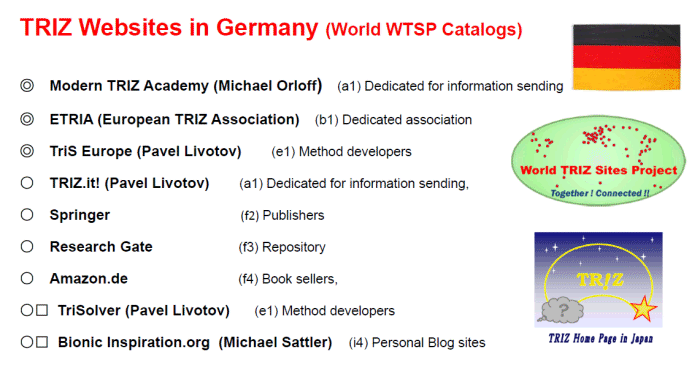
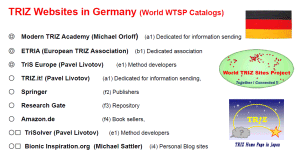
Manuscript of the Germany WTSP Catalogs has been built and incorporated as the Germany Part of the World WTSP Catalogs. The raw data of the 4th-round Internet survey of TRIZ Sites located in Germany are used to visit the 68 websites one by one to write brief introductions. We have found 4 ◎, 4 ○, 8 □, and 3 △ TRIZ Sites, and 5 ○, 8 □, and 4 △ Around-TRIZ Sites from this survey. The data already posted in the WTSP Catalogs (i.e., 2nd-round survey (TN2A, TN2F) for TRIZ sites and 3rd-round survey (TN3A2, TN3B, TN3C, TN3D, and TN3E) for Around-TRIZ sites) are also used to pick up the Germany sites.
Thus the Germany WTSP Catalogs contain 3 ◎, 6 ○, 7 □, and 3 △ TRIZ Sites and 2 ◎, 7 ○, 18 □, and 6△ Around-TRIZ Sites. Index Table of all these sites and Site descriptions of them are incorporated as the Germany Part of the World WTSP Catalogs (even though the Index parts of the World Catalogs are not updated yet).
We can learn a lot from all these websites. Especially the ◎ websites are:
Modern TRIZ Academy, ETRIA, TriS Europe for TRIZ; and Research Gate, LinkedIn for Around-TRIZ. There may be many good websites missing in the list. We wish TRIZ colleagues in Germany to revise and enhance the list of sites and the descriptions of individual sites. |
|
Click to enlarge
|
--- Several more countries active in TRIZ are left to have similar Country Catalogs; such as France, Italy, Taiwan, South Korea, ... In such countries, many websites are written in their non-English languages, and hence it will be difficult for a foreigner like me to build WTSP Catalogs of such countries, even with the help of translation software. Visiting and writing introductory notes of individual sites (in English) are the most basic jobs expected for TRIZ colleagues in each country; I will be ready to collaborate with you to brush your manuscripts up into Country WTSP Catalogs.
TRIZ Introduction: Altshuller and History of TRIZ (Tomasz Arciszewski) (Dec. 8, 2022) Japanese translation (Toru Nakagawa) (Dec, 8, 2022)
[1] The main body of this page is contributed by the Author (Prof. Tomasz Arciszewski) and permitted by the Publisher (Talylor & Francis Group) to reproduce and post on this website in English and in Japanese translation. [From "Inventive Engineering: Knowledge and Skills for Creative Engineers", Edn. 1, by Tomasz Arciszewski, Sections 9.1 - 9.2 (pp. 285-294) with 8 references mentioned there and Fig. 9.1, Copyright@2016 by CRC Press. Reproduced by permission of Taylor & Francis Group.] It is compact and comprehensive introductions to Altshuller (Section 9.1) and the (early) History of TRIZ (Section 9.2), which intermingle with each other. We may understand that the former describes the facts and background of Altshuller's life, while the latter the emergence and development of the concepts in TRIZ through the life stages of Altshuller. The atmosphere and influences of Soviet society on Altshuller's life are well described. The novelty/creativity of Altshuller's work in finding various essence (like principles/patterns/laws) from a huge body of technological information is evaluated as pioneering work of inductive knowledge acquisition (or Machine Learning in our present terminology).
|
|

Prof.
Tomasz Arciszewski
|
[2] (Selected) communications with the Author and myself record how this posting became possible.
[3] The Author has written down a new article: "New Introduction to "Inventive Engineering": Six Years Later" (Tomasz Arciszewski, Oct. 17, 2022). He emphasizes the 5-part structure of the Book: Motivation, Background Knowledge, Terminology, General Designing Process, and then five Individual Methodics (including TRIZ).
On the 24th Anniversary of "TRIZ Home Page in Japan": Toru Nakagawa (Nov. 12, 2022)
This Web site "TRIZ Home in Japan" celebrated its 24th Anniversary on Nov. 1. It serves as an open forum of information exchange for better understanding and usage of Creative Problem Solving Methodologies. I am very grateful to you all, including authors, co-authors, translators, and readers in Japan and around the world, for your continuing support.
The WTSP Project for Creating Catalogs of TRIZ-related Websites in the World has been carried out for nearly 5 years. As for the websites Around-TRIZ, I have just finished a WTSP World Catalog which contains 33 ◎, 142 ○, and 244 □ websites with surveyor introductions in a well-balanced manner. On the other hand, the WTSP Catalog of TRIZ websites is still insufficient and unbalanced, due to the lack of colaborative work in several countries leading TRIZ. We need much more effort for making the WTSP Catalogs useful and attractive. |
|


|
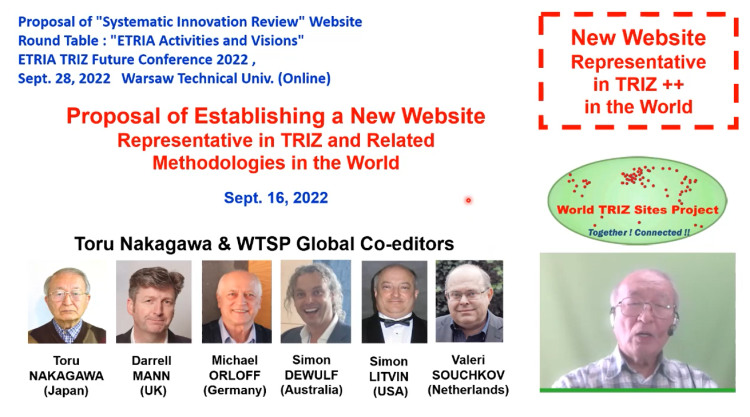
I noticed that the TRIZ community is weak because of missing a representative website (or journal) even though there exist a few international conferences and many consulting firms and academic groups working competingly. I and five WTSP Global Co-editors have proposed to establish a new website (tentatively named "Systematic Innovation Review") by international and interdisciplinary cooperation in the TRIZ community. The new website should accept various/different approaches in TRIZ (and later, more widely, Creative Problem-Solving Methodlogies in general), and publicize various aspects of articles (such as philosophy, methodologies, applications, introductions, educational texts, activities, etc.). In place of unpublished original papers, we should put weights on overviews and reviews on emerging/established works, to represent and lead TRIZ and related methodologies in the world.
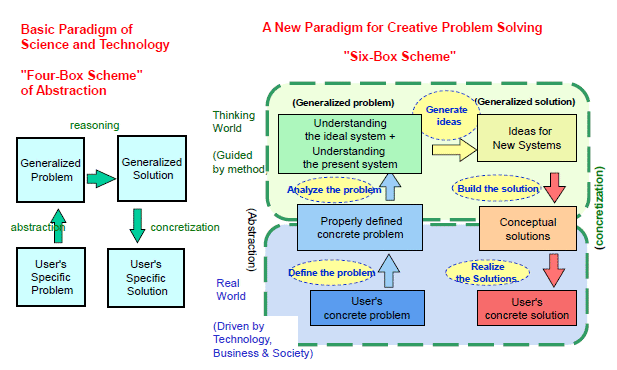
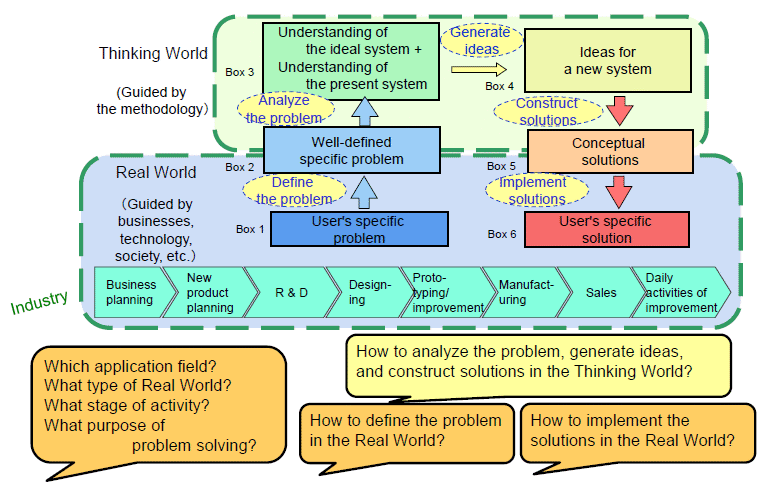
I am going to work to extend and promote further the Six-Box Scheme as the basic paradigm for Creative Problem-Solving Methodologies in general, and USIT as a concise and effective process for performing the Six-Box Scheme . I will also develop this "TRIZ Home Page in Japan" further as a prototype of the "SI Review".
I wish this Home Page is useful for you readers to solve your various problems. Your contributions either in English or in Japanese are heartily welcome.
From the Editor: The 'New Information' Posted in 2019 and 2020 Are Moved to an Archive Page. (Nov. 10, 2022)
WTSP Forum: Communications with WTSP Members and Readers: 2022 (Editor: Toru Nakagawa)  (Oct. 3, 2022)
This page is a Communication Forum for the WTSP Project among WTSP Teams, Members, Readers, etc. together with WTSP Leader and Global Co-editors.
Initiation of WTSP Team work in Korea (TN <=> Min-Gyu Lee, Aug.-Sept. 2022) ;
Initial stage of WTSP work in France (TN <=> Denis Cavallucci, Aug.-Sept. 2022).
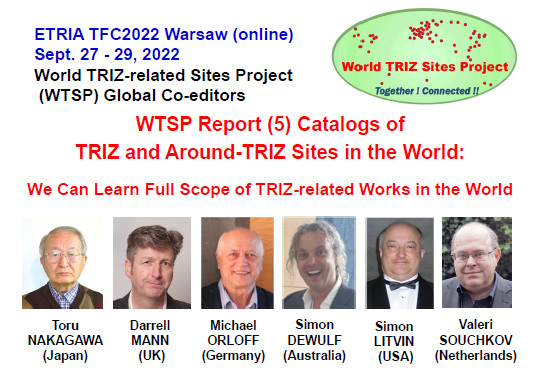
WTSP Paper (ETRIA): WTSP Report (5) Catalogs of �TRIZ and Around-TRIZ Sites in the World: � �We Can Learn Full Scope of TRIZ-related Works in the World (Toru Nakagawa, Darrell Mann, Michaael Orloff, Simon Dewulf, Simon Litvin, Valeri Souchkov) (Sept. 30, 2022)
WTSP Paper (JTS): WTSP World TRIZ Sites / Around-TRIZ Sites Catalogs (5) Useful & Attractive Information Source �-- Use Actively and Improve Them Further (Toru Nakagawa, Darrell Mann, Michaael Orloff, SImon Dewulf, Simon Litvin, Valeri Souchkov) (Sept. 30, 2022)
We gave this presentation at Japan TRIZ Symposium 2022. In the Japanese page, we post Abstract, Presentation slides (26 slides, in HTML and in PDF ), and Presentation video (in MP4, 19 min). In the English page , we post Abstract and Slides (26 slides, in PDF ). These 26 slides in English cover some more than the 13 slides presented at ETRIA TFC2022.
"SI-Review" Proposal: Proposal and Discussions of Establishing "Systematic Innovation Review" Website: Index Page (Editor: Toru Nakagawa) (Aug. 30; Sept. 16; Oct. 14, 2022) (Aug. 30, 2022)
This opens a new sub-site for the Proposal of Establishing "Systematic Innovation Review" Website (or "SI-Review" in short). It aims at making a "Representative" website in TRIZ and Around-TRIZ (i.e., Creative Problem Solving Methodologies in general).
The proposal was initiated mid June by Toru Nakagawa in relation to WTSP Project and was discussed inside the WTSP Global Co-editors. We have recognized that in the field of TRIZ there exist a number of international associations/conferences and many good websites operated by various consulting firms and academic groups, but no representative website we have (since Official Altshuller Foundation site is an archive site and TRIZ Journal is not active since 2020). We wish to have a website where excellent papers/articles come from various authors over the field and are published regularly, so that many professionals/users/learners can learn the whole aspects of TRIZ easily and effectively.
The proposal is just an initial/preliminary stage, and we should make the vision clearer and should create a general consensus in the TRIZ community in the world. We have decided to open this sub-site temporarily inside the WTSP website, as a place for presenting and discussing about the Proposal. Please feed back your (or your organizations/groups) thoughts here. By the collaboration of the whole TRIZ community, we wish the vision of such a Representative website come true in the near future.
Proposal of "Systematic Innovation Review" Website (Toru Nakagawa & WTSP Global Co-editors (Darrell Mann, Michael Orloff, Simon Dewulf, Simon Litvin, Valeri Souchkov)) (.docx ) (Aug. 30; Sept. 16; Sept. 22, 2022)
This is the Proposal of "Systematic Innovation Review" Website, in its initial stage. The Proposal will be shown here step by step to make the vision clearer, along with the feedback and discussions from readers and various TRIZ organizations/groups. Section 1 is posted on Aug. 30, and the full body (from Section 2 to Section 8) is posted on Sept. 16, 2022. Key phrases are shown in bold face. (Sept. 22, 2022),
1. Vision of the Proposal of Establishing "Systematic Innovation Review" Website (Aug. 30, 2022)
What is the Purpose / Value Proposition ? ; Background: Current status of methodologies and websites in the relevant fields ; Scope of the "Systematic Innovation Review" website ; Naming of our website: "Systematic Innovation Review" (website) ; Categories, Nature, and Quality of articles ; How to collect/get good manuscripts ; Organization for promotion and operation ; Relationships with other organizations and websites/journals
2. Who Are Users/Readers and Authors? Needs of Contents. (Sept. 16, 2022)
Professionals in TRIZ ; Ordinary Users/Practitioners in TRIZ ; Beginners in and Unfamiliar to TRIZ ; Professionals in various methodologies around TRIZ ; Ordinary Users/Practitioners in Various Methodologies around TRIZ ; People Unfamiliar to Any Metho ; Need to Categorize Articles/Papers in the SI-Review website
3. Organization for Promoting and Operating the SI-Review Website (Sept. 16, 2022)
Initiation of Proposal by the WTSP Global Co-editors ; Our basic philosophy for getting collaboration of different organizations/groups ; Getting cooperation with TRIZ international organizations: MATRIZ, AI, ETRIA, SSI ; Big conflicts in the TRIZ community --- How can we solve them? ; Possible forms of Organization for Proposal Promotion and SI- Review Website Operation ; Forming the SI-Review Project by the support of the TRIZ community
4. Editorial Board, Editorial Advisory, and Editorial Office/Staff (Sept. 16, 2022)
Editorial Board ; Editorial Advisory ; Editorial Office/Staff
5. Process of Preparing Manuscripts of Papers/Articles (Sept. 16, 2022)
Preparation by the Editorial Office ; Collecting/inviting the articles/papers: Pool of candidate articles ; Submission of Manuscripts of Articles by the Author(s) ; Peer Review Process: Single-Blind Peer Review
6. Structure and Editorial Operation of the SI-Review website (Sept. 16, 2022)
Setting up the SI-Review website: Web Platform in the Cloud ; Basic Editorial Operation inside the SI-Review website ; Structure of SI-Review Website: Categorized Sections ; Links to references and relevant articles
7. Usage of SI-Review by Readers (Sept. 16, 2022)
Use of SI-Review: Registration or not ; Allowance of usage by the readers ; Communication from readers/users
8. Financial Issues of SI-Review (Sept. 16, 2022)
Possible Costs ; Possible alternative ways of Income
Discussion Page in the Initial Stage on: Proposal of "Systematic Innovation Review" Website ( ) (Editor: Toru Nakagawa) (AUg. 30; Sept. 16, 2022)
Feedbacks from various TRIZ organizations, groups, and individuals will be posted here.
Tomasz Arciszewski (USA) Comments; Jura Danilovskij (Korea & Russia) Strong support ;
Paper: Modern Tools for Business TRIZ (Valeri Souchkov (ICG Training and Consulting, The Netherlands)) (Japanese translation by Toru Nakagawa) (Jul. 30, 2022)
This is an excellent overview paper by Valeri Souchkov on the extension of TRIZ to the field of Business and Management. As the result of his (and others') research and practices, he has shown a full system of Modern (Adapted and New) Tools of TRIZ applicable to understand and solve various problems in Business and Management. He has recently organized the International Business TRIZ Association (IBTA) and installed the tools system (most of which he developed in ICG T&C) as the course material of the IBTA training & certification. Reading this overview, you are invited to read futher about the methods (or tools) for Business TRIZ through the References listed at the bottom.
This paper was presented at MATRIZ TRIZfest-2021, and may be referred in their open website. I obtained Author's permission of translating this paper into Japanese and posting it here both in English and in Japanese (on Jan. 1, 2022). I am very gratefull to Mr. Valeri Souchkov for his permission, and am happy to post it here in the two languages, with my apologies for so much delay. Fortunately, Japan TRIZ Society is inviting Valeri Souchkov as the Keynote Speaker in the coming Japan TRIZ Symposium 2022 (Sept. 1 - 2, 2022, online).
Note (TN, Nov. 1, 2022) This page was broken during Oct. 14 through Oct. 31, 2022 due to my mistake. Sorry for your inconvenience. |
|

Mr. Valeri Souchkov
|
Paper: From the "Four-Box Scheme of Abstraction" in Science and Technology to the "Six-Box Scheme" for Creative Problem Solving (Toru Nakagawa) (Jul. 22, 2022)
Extending the Proceeidngs paper (8 pages) presented at the Conference of Japan Creativity Society (JCS), a full paper (20 pages) has been written in Japanese and publicized in this "TRIZ Home Page in Japan". The two schemes are shown in comparison in the Figure shown in the right.
The paper was written and submitted to the Journal of Japan Creativity Society on Dec. 18, 2022. However, JJCS rejected my paper saying NOT "a new, unpublished, original work", and on my claim of this paper being "a full, new, overview paper of my original work for over 20 years", they decided not acceptng an overview paper (in Feb. 2022). Thus I posted my paper in this website, together with my review request to the JJCS Editors in Japanese. Translation of the full paper into English may be delayed much. |
|
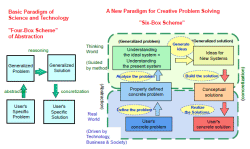
Click to enlarge |
WTSP: WTSP Catalogs of (C) Around-TRIZ Sites in the World are Revised and Extended (Jun. 3, 2022)
By integrating the survey results described so far, the WTSP World Catalogs of (C) Around-TRIZ Sites are revised. Importantly, all the sites at the □ level (worthy in the World Catalog) are now shown in the (C3) WTSP World Around-TRIZ Sites Extended Catalog. (Note: Catalogs for Print (C1P) and (C2P) are going to be updated in a few weeks.)
World Catalog |
Contents |
Index page |
Sites Description |
Latest Beta Editon |
Revision |
| ◎ or ◎○ |
○ or ○□ |
□ or □△ |
(C1) World Around-TRIZ Top Catalog (◎) |
30 |
- |
- |
 |
Separated |
May 30, 2022 |
Jun. 3, 2022 |
(C2) World Around-TRIZ Basic Catalog (◎○) |
30 |
143 |
- |
|
Separated |
May 30, 2022 |
Jun. 3, 2022 |
(C3) World Around-TRIZ Extended Catalog (□) |
- |
- |
244 |
|
Separated |
- |
Jun. 3, 2022 |
The numbers of sites listed in the Catalogs are shown below after classifying with the Evaluation grades and the Roles of site.
WTSP Catalogs : Enhancing the World WTSP Catalogs of (C) Around-TRIZ Sites (Toru Nakagawa) (Apr. 1; Apr. 11; Apr. 27; May 9, 2022)
We wish to make the World WTSP Catalogs really Useful and Attractive for learning different and abundant approaches to Creative Problem Solving and Innovation in the world. We have 3 main routes for such cooperative work: (1) Building Counntry WTSP Catalogs (of TRIZ sites at first) in each country, (2) Getting Introductions of individual sites written by the site owners themselves (in the Standard Form and optional closer description), and (3) Improving the survey results of Around-TRIZ websites. Whenever such manuscripts are submitted, I am ready to post them one by one in this WTSP website. I am going to work along Route 3 for myself, and post the results step by step in this page. |
|

For the people of Ukraine.
|
| |
 Revised the Survey TN3A2 (Creative Think Method) of Around-TRIZ Sites (Toru Nakagawa) (Apr. 1, 2022) Revised the Survey TN3A2 (Creative Think Method) of Around-TRIZ Sites (Toru Nakagawa) (Apr. 1, 2022)
Visiting all the sites in TN3A2 again, their site introductions are enhanced (especially for □ sites). Both the Index page ( Index-TN3A2.html) and Site Description page ( Sites-TN3A2.html) are fully updated. These updates are naturally reflected in the World WTSP Catalogs (except the Print-type Catalogs). The following 10 sites are newly evaluated at the ○ level: TN3A2-20 Peter Fisk, TN3A2-21 The Creativity Post, TN3A2-22 Mind Tools, TN3A2-36 Simplicable (by John Spacey), TN3A2-42 IQ Matrix (by Adam Sicinski), TN3A2-71 Fairfax County Public Schools, TN3A2-61 Fast Company, TN3A2-84, NCBI (National Center for Biology Information), TN3A2-85 ToolsHero. |
|

At National Museum, Mar. 24
|
| |
Revised the Survey TN3B (Creative Problem Solve) of Around-TRIZ Sites (Toru Nakagawa) (Apr. 11, 2022)
Visiting all the sites in TN3B again, their site introductions are enhanced (especially for □ sites). Both the Index page ( Index-TN3B.html) and Site Description page ( Sites-TN3B.html) are fully updated. These updates are naturally reflected in the World WTSP Catalogs (except the Print-type Catalogs). The following 9 sites are newly evaluated at the ○ level: TN3B-43 Frontiers, TN3B-52 ERIC (Institute of Education Sciences, U.S. Department of Education), TN3B-65 Britannica, TN3B-71 NCTL (National Center for Technological Literacy) : EiE (Engineering is Elementary), TN3B-79 ITHAKA : JSTOR, TN3B-88 Study.com, TN3B-90 Creative Education Foundation, TN3B-37 Lucid chart, TN3B-83 World Scientific - Connecting Great Minds. |
|

At Kashiwanoha Park, Apr. 7
|
Revised the Survey TN3C (Innovation) of Around-TRIZ Sites (Toru Nakagawa) (Apr. 27, 2022)
Visiting all the sites in TN3C again, their site introductions are enhanced (especially for □ sites). Both the Index page ( Index-TN3C.html) and Site Description page ( Sites-TN3C.html) are fully updated. These updates are naturally reflected in the Site descriptions of the World WTSP Catalogs (except the Print-type Catalogs), but not yet in the Index pages of the World WTSP Catalogs. The following 2 sites are newly evaluated at the ○ level: TN3C-36 Study Portals, TN3C-71 SRI International .
Revised the Survey TN3D (Quality) of Around-TRIZ Sites (Toru Nakagawa) (May 9, 2022)
Visiting all the sites in TN3D again, their site introductions are enhanced (especially for □ sites). Both the Index page ( Index-TN3D.html) and Site Description page ( Sites-TN3D.html) are fully updated. These updates are naturally reflected in the Site descriptions of the World WTSP Catalogs (except the Print-type Catalogs), but not yet in the Index pages of the World WTSP Catalogs. The following 3 sites are newly evaluated at the ○ level: TN3D-55 Edraw, TN3D-97 Dassault Systems: 3DS, TN3D-122 Scrum Guides.
Revised the Survey TN3E (Patent) of Around-TRIZ Sites (Toru Nakagawa) (May 18, 2022)
Visiting all the sites in TN3E again, their site introductions are enhanced (especially for □ sites). Both the Index page ( Index-TN3E.html) and Site Description page ( Sites-TN3E.html) are fully updated. These updates are naturally reflected in the Site descriptions of the World WTSP Catalogs (except the Print-type Catalogs), but not yet in the Index pages of the World WTSP Catalogs. The following 2 sites are newly evaluated at the ○ level: TN3E-47 Udemy, TN3E-55 Entrepreneur.
All the 5 survey cases are now updated. The World Around-TRIZ Sites Catalogs will be wholy updated in a week or two.
WTSP Catalogs : UK Part of the World WTSP Catalogs Has Been Built as an Example of Country WTSP Catalogs (Toru Nakagawa) (Mar. 2, 2022)
Manuscript of the UK WTSP Catalogs has been built and incorporated as the UK Part of the World WTSP Catalogs. The raw data of the 4th-round Internet survey of TRIZ Sites located in the United Kingdom are used to visit the 39 websites one by one to write brief introductions. We have found 5 ◎, 1 ○, 8 □, and 1 △ TRIZ Sites, and 2 ◎, 3 ○, 6 □, and 3 △ Around-TRIZ Sites from this survey. The data already posted in the WTSP Catalogs (i.e., 2nd-round survey (TN2A, TN2F) for TRIZ sites and 3rd-round survey (TN3A2, TN3B, TN3C, TN3D, and TN3E) for Around-TRIZ sites) are also used to pick up the UK sites. Thus the UK WTSP Catalogs contain 6 ◎, 5 ○, 9 □, and 1 △ TRIZ Sites and 4 ◎, 13 ○, 31 □, and 3 △ Around-TRIZ Sites. Index Table of all these sites and Site descriptions of them are incorporated as the UK Part of the World WTSP Catalogs (even though the Index part of the World Catalogs are not updated yet). We wish TRIZ colleagues in UK to revise and enhance the list of sites and the descriptions of individual sites.
We can learn a lot from all these websites. Especially the ◎ websites are:
The TRIZ Journal, Systematic Innovation Inc., Oxford Creativity. CORE for TRIZ; and Project Smart, Managing Innovation (John Bessant), My Mooc, Science Direct for Around-TRIZ. [There may be many good websites missing in the list. I notice Bio-TRIZ site (◎) is a case of missing. ]
Paper: From the "Four-Box Scheme of Abstraction" in Science and Technology to the "Six-Box Scheme" for Creative Problem Solving (Toru Nakagawa) (Dec. 10, 2021) (Jan. 16, 2022) (Feb. 19, 2022)
This paper has been presented in Japanese at the Conference of Japan Creativity Society on Oct. 3, 2021. A full set of records, i.e., paper (in HTML and in PDF ), presentation slides (in PDF ), and video (in MP4 ), were posted in Japanese on Dec. 10, 2021. The paper and the Slides in English translationare now posted: Paper in HTML and in PDF and Slides in HTML and in PDF . The Abstract of the paper is:
| |
Science and technology have the "Four-Box Scheme of Abstraction" as the basic paradigm, and solve problems by applying them to models (theories) established in every field. This is not effective for "Creative Problem Solving", where a new way of thinking (theory) itself is to be found. Thus, various researches on "Creativity Methods" for Creative Problem Solving have made different approaches without a basic paradigm. Among them, TRIZ and USIT have prepared for a new development. The author introduced both of them, integrated the huge TRIZ into the concise USIT, and from the data-flow representation of the USIT process obtained the "Six-Box Scheme". Having shown many TRIZ/USIT problem solving cases in the "Six-Box Scheme", he is advocating the Scheme as a new "Basic Paradigm of Creative Problem Solving". Now that the Scheme has established the problem-solving process in the "Thinking World", the diversity of problem situations in the "Real World" is the focus of research in future. It would be meaningful to examine various Creativity Methods and reposition and integrate them in the "Six-Box Scheme". |
|
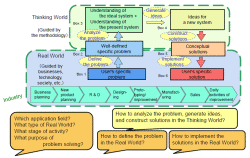
Click to enlarge
|
From the Editor: Using LinkedIn, Google Scholar, and ResearchGate in Addition to Websites and Emails (Toru Nakagawa) (Feb. 6, 2022)
For reporting my research works and for spreading the information widely, I have been using several means, just like many other people. In this page, I would like to summarize some of them, with emphasis on recent means.
WTSP Catalogs Introduction: Introduction to World WTSP Catalogs of TRIZ Sites and Around-TRIZ Sites (Toru Nakagawa) (Jan. 24, 2022; Jan. 26, 2022)
This is an Introduction for ordinary users without assuming any knowledge about WTSP or its Catalogs. Originally written in 23 slides and posted in HTML and in PDF . Here is its Abstract:
(1) Catalogs of TRIZ-related Websites in the World have been developed by a volunteer-based international project WTSP.
(2) The Catalogs are now available publicly without charge both for interactive use at the WTSP site and for downloading, printing, and interactive use at user's PC.
(3) The Catalogs cover various websites in the fields of TRIZ (including modernized TRIZ) and around-TRIZ more widely (i.e., creative problem solving in general, including quality/value/project management, IP, etc.).
(4) Various websites dedicated for the roles of information sending, research, development, promotion, publishing, etc. of such TRIZ-related methodologies are collected.
(5) Websites are found more useful as units of information resources than (smaller) webpages, papers, patents, etc. and (larger) journals, conferences, books, etc., because they are kept updated for many years with unity/quality/scope of information by some group or organization, in openly accessible forms.
(6) Individual websites are introduced briefly by surveyors/recommenders, and in one-page standard form and (optionally) much longer by the website owners.
(7) Websites are evaluated in respect to their quality/usefulness/attractiveness/ accessibility/scopes/etc. and shown in 5 grades (◎○□ for world level, △ for country level, and -).
(8) Current World WTSP Catalogs (Beta Edition) list 23 ◎ and 39 ○ websites in TRIZ while 33 ◎ and 127 ○ websites around TRIZ.
(9) We are working further to make our WTSP Catalogs more useful and attractive for users as well as professionals by voluntary cooperation of many colleagues in the world.
(10) Let's work Together ! Connected !! |
|
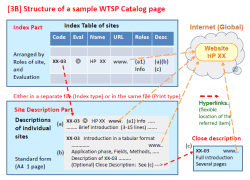
Click to enlarge
|
Table of Contents is (Briefly) : [1] Introduction: Purposes/Aims and Basic Strategy ; [2] Activities for Building WTSP Catalogs ; [3] Structure of World WTSP Catalogs (Beta Edition) ; [4] Most Important Sites in the World WTSP Catalogs ; [5] Concluding Remarks (with References)
Note (TN, Jan. 26, 2022) I made minor revisions in 3 slides, including the one [3B] shown above.
WTSP : (A9) Introductions of the World WTSP Catalogs for Users (Jan. 24, 2022)
A new page has been started just under the WTSP Index page. It is the entrance page for users to learn and enjoy using the World WTSP Catalogs. See the Introduction (Jan. 24, 2022)
Basic Theory: Papers by Toshio Takahara (The 6th Collection) (2020 -2021): Never-Finished Notes on Philosophy: Logic, World View, Way of Life, and Preparing for Post-Capitalism (Collection of 19 papers) (Toshio TAKAHARA) (Jan. 16. 2022)
"TRIZ Home Page in Japan" has recognized much the importance of Mr. Toshio Takahara's research work and has been collecting and posting all his academic works since 2003. This English page is the brief introduction to the Japanese pages of "the 6th Collection of Toshio Takahara's Papers" covering 19 works shown in the following table.
[Ref. No.] |
Title |
Source (Year) |
Language, Form, No. of pages |
Posted in HTML |
Posted in PDF, MP4 |
[55] |
Enumeration of Reasoning and Formulation of Abduction -- Supplement to Takahara [50] |
RET 2020 (THPJ Feb. 11, 2020) |
Japanese, 3 pages |
|
|
[56] |
Facts Decide Outline of a Simple Logic, a Way of Life and a Society |
FIT2020 (Oct. 6, 2020) |
Japanese, 4 pages |
|
Slides |
[57] |
The Structure of Thinking and Essence of Logic |
CGK2020 (2020.10.24) |
Japanese, 2 pages |
|
Slides |
[58] |
The Condition That Unify Usual Reasoning into Abduction |
IPSJ2021 (2021. 3 ) |
Japanese, 2 pages |
|
Slides |
[59] |
The Historically Logical Structure of Philosophy Made by Dialectic Logic |
FIT2021 (2021.8.25-27) |
Japanese, 2 pages |
|
Slides
|
[60] |
"Never-Finished Notes on Philosophy : Contradiction Model, Radical Enumerable Thinking and World View, Way of Life, and Post-Capitalism" (11th Edition, Feb. 2021) |
Book B5 V11 All |
Japanese, 144 pages in B5 |
|
|
[61] |
"Never-Finished Notes on Philosophy : Contradiction Model, Radical Enumerable Thinking and World View, Way of Life, and Post-Capitalism" (14th Edition, Jun. 2021) |
Book B5 V14 All |
|
|
|
[62] |
"Never-Finished Notes on Philosophy : Contradiction Model, Logical Enumerable Thinking and World View, Way of Life, and Post-Capitalism" (17th Edition, Oct. 2021) Parent page |
Book B5 V17 All |
|
|
|
[62A] |
[62] Part A. Introduction, Table of Contents, Preface, Abstract, etc. // Afterword, Acknowledgment, References, etc. |
Book B5 V17 Part A (Preface, Abstract, Postscript) |
|
|
|
[62B] |
[62] Part B. Chapter 1. Facts, Basic Concepts, Values and Thinking |
Book B5 V17 Part B (Facts, Basic Concepts) |
|
|
|
[62C] |
[62] Part B. Chapter 2. Dialectic Logic: Contradiction Model and Logical Enumerable Thinking; Chapter 3. Contradiction Model (Movement Model) |
Book B5 V17 Part C |
|
|
|
[62D] |
[62] Part D. Chapter 4. Logical Enumerable Thinking: Concepts and Methods |
Book B5 V17 Part D |
|
|
|
[62E] |
[62] Part E. Chapter 5. Objectizing and Unifying, Way of Life based on the Unification of Liberty and Love |
Book B5 V17 Part E |
|
|
|
[62F] |
[62] Part F. Appendices: Revisiting Karl Marks, Unified Theory on Humankind, Logics in Universe and their Assumptions |
Book B5 V17 Part F |
|
|
|
[62G] |
[62] Part G. Second Part: Preparation for Post-Capitalism |
Book B5 V17 Part G |
|
|
|
[63] |
"Never-Finished Notes on Philosophy: Vol. I Logics, World View, for Way of Life" (5th Edition, A5 size) |
Book A5 V5 Part1 |
|
|
|
[64] |
"Never-Finished Notes on Philosophy: Vol. II Logics in Universe and Preparation for Post-Capitalism" (5th Edition, A5 size) |
Book A5 V5 Part2 |
|
|
|
[65] |
Annotated Bibliography of Takahara's Papers (2016 -2021) |
Guide 2016-2021 |
|
|
|
[66] |
Abstract and History of "Never-Finished Notes on Philosophy" (Overview) |
Overview -2021 |
|
|
|
The book [62] "Never-Finished Notes on Philosophy" (17th Edition, Oct. 2021) is his principal work at the present stage. It has 144 pages in B5 size. Because of its large volume, I have posted it in 8 web pages [62A] through [62G] in HTML. [62G] is the Second Part of the book, where he proposes to prepare for shifting the world toward 'Post-Capitalism, where money is no longer the only Value' in one-hundred or one-thousand years in future. It is really a big vision. Nakagawa is responding to him at the Editor's Post-Note of [62G].
The figure below conceptually illustrates the structures (and transitions) of the themes the author has been discussing for these two decades since 2003. |
|
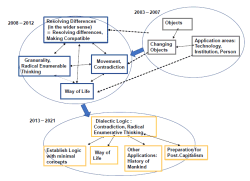
Click to enlarge
|
Basic Theory: Papers by Toshio Takahara (The 5th Collection) (2018 -2019): Never-Finished Notes on Philosophy: Logic, World View, Way of Life, and Preparing for Post-Capitalism (Collection of 11 papers) (Toshio TAKAHARA) (Jan. 14, 2020; Jan. 16. 2022)
The page "Papers by Toshio Takahara (2018 -2019)" posted on Jan. 14, 2020 has been re-adjusted to be the parent page of the 5th Collection of Toshio Takahara's Papers. The Collection contains 11 papers, where the book "Never-Finished Notes on Philosophy" (First Edition, Feb. 2019) is his principal work at the time. For the introduction in English to the Paper Collection, I recommend the article (2019) [44-47] "Revised Abstract (2019) of "A Working Research Note on Philosophy (2018)" .
From the Editor: Message for the New Year 2022 (Toru Nakagawa, Jan. 3, 2022) (Jan. 16, 2022)
On the start of New Year 2022, I wish you all the year be healthy, happy, successful, and the World be peaceful and recovering from the pandemic. The photo in the right shows the New Year Card I sent with my wife to our relatives and friends in Japan. Clicking it will guide you to its English version for you :
For the Coming Spring Hoping ever lasting friendship with you ! Wishing you good health and happiness !
The conventional "Four-Box Scheme of Abstraction" in science and technology guides us in applying established theories, while the "Six-Box Scheme" of Creative Problem Solving (which I proposed in 2005) guides us in creating new ideas (or theories), I now understand clearly. I will keep working in research and proliferation, beyond traditional TRIZ. At the age of 81, I am doing fine. (Toru)
Just like Mii-chan in the children song "Springtime, Come quick! Wish to walk out with the red-strapped zori ! ...", I am waiting for the springtime while spending days almost being locked down due to the Covid-19 pandemic. Want to go around outdoors without wearing the mask! (Masako)
January 1st, 2022 Toru and Masako Nakagawa |
|
Click to the card in English
|
Posted in 2021
Paper: From the "Four-Box Scheme of Abstraction" in Science and Technology to the "Six-Box Scheme" for Creative Problem Solving (Toru Nakagawa) (Dec. 10, 2021) (Jan. 16, 2022) (Feb. 19, 2022)
This paper has been presented in Japanese at the Conference of Japan Creativity Society on Oct. 3, 2021. A full set of records, i.e., paper (8 pages) in the Proceedings (in HTML and in PDF ), presentation slides (21 slides in PDF ), and (rehearsal) video (25 min. in MP4 ), have been posted in Japanese on Dec. 10, 2021.
[Editor's Note (TN, Feb. 19, 2022): The paper and the Slides have been posted here in English translation. See Paper in HTML and in PDF , and Slides in HTML and in PDF . ]
I have shown:
(a) "Four-Box Scheme of Abstraction" is the basic paradigm in science and technology in general, but it is not applicable to creative problem solving. (b) Conventional researches and applications of Creativity Methods have been working in various approaches being confused without finding a suitable paradigm. (c) TRIZ and USIT have prepared for the transition to the new paradigm for Creative Problem Solving. (d) The "Six-Box Scheme" obtained through TRIZ/USIT is found to be the new basic paradigm for Creative Problem Solving.
The figure illustrates "Four-Box Scheme" and "Six-Box Scheme" side by side. "Four-Box Scheme" has been used in every area of science and technology. However, its processes, i.e., abstraction, reasoning, and concretization, cannot be explained in general without using examples. On the other hand, "Six-Box Scheme" illustrates the skeletal process to be followed when trying to solve a new problem/issue ("creative problem solving"). For each step of the process, many general theories and methods are already known for guiding users. It is this "framework", or basic paradigm or guiding principle, that has to be revealed so far. It can guide all the important work in Research and Development and in various Innovations. I realized and proposed this "Six-Box Scheme" 16 years ago in 2005 . We hope the new paradigm become widely known and effectively applied in Japan and all over the world. |
|
Click to enlarge
|
WTSP : Current Status of the Survey Results of WTSP World TRIZ Sites, and Overview of Deployment of TRIZ in the World (Toru Nakagawa) (Nov. 20, 2021)
This page shows the summary of results of the 4th-round Internet Surveys of TRIZ Sites in Individual Countries on which I worked for these 7 months since May 2021. It covers 52 countries and 3 language groups. The raw results are shown in individual HTML pages under the parent page . An Excel file of the data in a summary form is posted there (Nov. 17, 2021).
Here, the 'selected TRIZ sites (◎○□△)' of individual countries in the world are gathered and shown in a new HTML page and a PDF file . Adding short notes of the data for the countries already shown in the Beta Edition, the Current Status of the Survey Results of WTSP World TRIZ Catalog is posted here. This gives an overview of TRIZ deployment in the whole world.
Editor's Note PS writes some notes for reading/using the present data and for making WTSP Catalogs more Attractive and Useful with the voluntary collaboration of many TRIZ leaders/colleagues in the world. In addition, my personal impressions of the overview on the global deployment of TRIZ are shown.
On the 23rd Anniversary of "TRIZ Home Page in Japan": Toru Nakagawa (Nov. 20, 2021)
This Web site "TRIZ Home in Japan" celebrated its 23rd Anniversary on Nov. 1. I am very grateful to you all, including authors, co-authors, translators, and readers in Japan and around the world, for your continuing support. This site serves as an open forum of information exchange for better understanding and usage of Creative Problem Solving Methodologies. |
|

|
The central activities for me for these years is the WTSP Project to construct Catalogs of TRIZ-related Websites in the World. Its basis is the realization of important roles of websites as the units of information resources over (smaller) individual papers/web pages and over (larger) journals/conferences/repositories. Catalogs of selected websites with appropriate introductions in any specific field/theme (like TRIZ) are good platforms for guiding general readers/users and for developing the field with 'Competition & Collaboration' among professionals. For making our World WTSP Catalogs more Attractive and Useful, we published 'WTSP Appeal 2021' in the names of six Global Co-editors together, and I made Internet Surveys of TRIZ websites in individual countries .
Last September I was much honored with TRIZ Champion Award 2021 by MATRIZ as an individual who contributed to deploy TRIZ in the world in 'Out of the Box' approaches. I wrote a note of my own way of 'Out of the Box (of traditional TRIZ, partly)' into much general 'Six-Box Scheme for Creative Problem Solving'. I should extend this Six-Box Scheme approach further.
This year I am much guided by Darrell Mann's works. I will work to introduce excellent works in the world in the bi-directional ways between Japan and the world. Readers' contributions either in English or in Japanese are heartily welcome. I wish this Home Page be useful for you readers to solve your various problems.
Paper : Matrix 2022: Re-Imagining The Contradiction Matrix (Darrell Mann) (ETRIA TFC2021) (Oct. 14, 2021)
This paper was presented by Darrell Mann at the ETRIA TFC2021 (Sept. 22-24, 2021). Since the Online video presentation was allowed only for 5 minutes, most participants were not able to fully appreciate it, I am afraid. I read the paper the day before and was amazed with its contents. I asked the author and got the permission to translate it into Japanese and to post it here on this website both in Japanese and in English. I would like to express my sincere gratitude to the author.
As you know well, the author, Darrell Mann, analyzed patents all over the world and greatly improved the TRIZ Contradiction Matrix into Matrix2003 and Matrix2010. He has been continuing his patent-analysis research project at Systematic Innovation. This paper describes his latest developments: (1) The "impact" of the contradiction solution (not only the impact on the current situation, but also the impact to be expected in future) is estimated and used as one of the criteria for recommending the inventive principles. (2) For each case of the matrix cell, all the 40 inventive principles are plotted on a two-dimensional graph of usage frequency vs impact. (3) For each case of the matrix cell, frequently-used combinations of the inventive principles are shown. (4) For the cases of conflicts not only between two parameters (dilemma), but also among three (trilemma), and among much more (even in "complicated" and in "complex" situations), an new algorithm has been developed to recommend inventive principles. (5) For implementing all these features, Matrix2022 has been developed newly in the form of an interactive app.
WTSP : WTSP Appeal 2021 Worlfd TRIZ-related Sites Project (WTSP) (4): World WTSP Catalogs of TRIZ Sites and Around-TRIZ Sites, Let's Make Them Attractive and Useful ! (Toru Nakagawa, Darrell Mann,�Michael Orloff, Simon Dewulf, Simon Litvin,�Valeri Souchkov) (ETRIA TFC2021) (Sept. 29, 2021)
This page posts our WTSP paper presented at ETRIA TFC2021, which was held on Sept. 22 - 24, 2021 online by the organization of Free University of Bozen-Bolzano, Italy.
(A) Slidess/video: The Conference requested pre-recorded video presentations for only 5 minutes (+ー30 seconds). Such a compact format fits well for our "WTSP Appeal 2021" we were planning to call by the six Global Co-editors. So we prepared a presentation of 8 slides with video record for 5 minutes 29 seconds. The slides are shown here in HTML
and in PDF , and the video is also posted here . The first and the last slides are shwon below. Japanese translation will be posted later. (Note: The 22 slides in English presented at Japan TRIZ Symposium 2021 may be of some help for you English readers.)
(B) Paper: We submitted our paper manuscript of 10 pages on Apr. 29, 2021 and slightly revised version after the review on Jun. 29, 2021. The paper has been published in the Conference Proceedings of Practioner Papers (in the form of a special issue of Acta Technica Napocensis of Technical University of Cluj-Napoca, Romania). The paper is shown here in HTML and in PDF (Note (Sept. 29, 2021): The PDF file in the Proceedings has been corrected by TFC2021: 1626-2813-1-SM.pdf ==> 1626-2813-2-PB.pdf .) |
|

Click to enlarge |
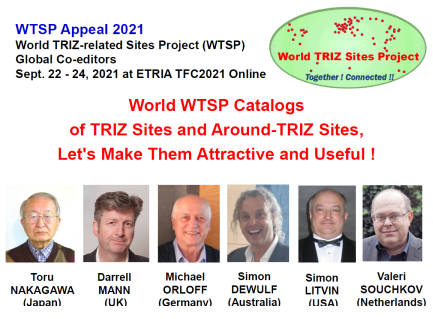
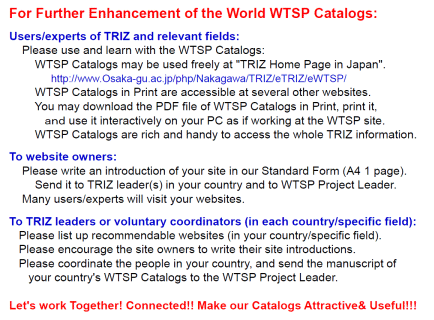
WTSP Paper: World TRIZ-related Sites Project (WTSP) (4): Construction and Enhancement of World WTSP Catalogs of TRIZ Sites and Around-TRIZ Sites (Toru Nakagawa, Darrell Mann,�Michael Orloff, Simon Dewulf, Simon Litvin,�Valeri Souchkov) (Japan TRIZ Symposium 2021) (Sept. 29, 2021)
This paper was presented at Japan TRIZ Symposium 2021, held Online on Sept. 2-3, 2021. Since the Symposium was not held last year 2020 becasuse of the COVID-19 pandemic, this presentation covers our WTSP activities and results for these two years. Besides the slides and video in Japanese, the sildes in English (displayed and published in the Symposium) are posted here in HTML and in PDF . 22 slides in English may be useful for English readers as more detailed information complementng the shortage of the 8 slides in the ETRIA TFC2021.
From the Editor: On Receiving the Honor of TRIZ Champion Award from MATRIZ (Toru Nakagawa) (Sept. 16, 2021)
|
On Aug. 27 morning I was much surprised with an email, saying that MATRIZ Board voted to offer its TRIZ Champion Award to me . The Award intends to honor the individuals who significantly contributed to TRIZ deployment worldwide especially with "Think outside of the box" .
On Sept. 1 I replied to accept the offer with my great pleasure of being honored . In the reply I described my thoughts and activities for these 24+ years in my own way of "Out of the box", partly implying "Out of the box (of traditional TRIZ)" . I very much appreciate the open-mindedness of MATRIZ in recognizing my activities. I am also very grateful for many people who guided, collaborated, supported, and learned together with me in Japan and in the world during these years. I wish to keep my activities going on as long as my health allows.
This page records the email from MATRIZ and my reply (inserting hyperlinks to relevant pages), and the photo of TRIZ Champion Award . |
|
Click to enlarge
|
General Index: Outline [Categorized table of all articles (in English/Japanese) accessible with a single click.]
[Kept always up to date. (Checked and improved on Jan. 9, 2013)]
Questions, comments, submissions, etc. on this home page are welcome via e-mail to:
Toru Nakagawa, Dr., Professor Emeritus, Osaka Gakuin University
E-mail: nakagawa@ogu.ac.jp [The same as before retirement. Email is the main communication channel.]